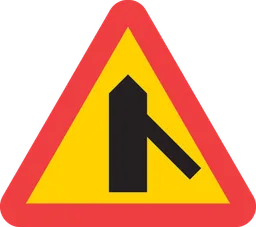
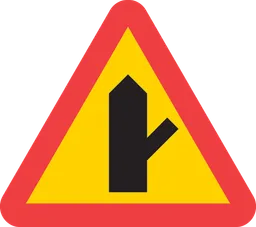
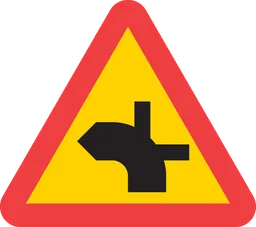
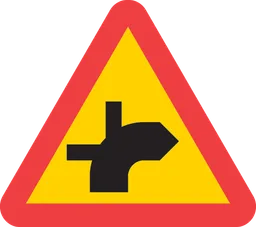
A1-1Warning Signs
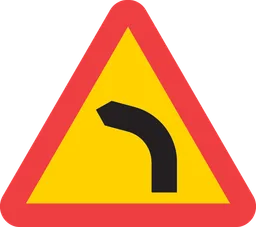
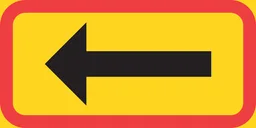
Dangerous curve, to the left
Swedish name: Varning för farlig kurva
The road sign warns of a dangerous curve, in this case a dangerous curve to the left. The curve is normally quite sharp and can be dangerous if you do not reduce the speed. The road sign is placed where it is inappropriate to follow the speed limit in the curve. In sharp curves, there is always a risk that an oncoming vehicle "cuts the curve" by driving in your lane where the curve is the sharpest. This can of course cause a very dangerous situation, especially if the view in the curve is obscured. In sharp curves with obscured visibility, you must also keep in mind that there may be children playing, pedestrians, animals or obstacles on the road just after the curve.
A1-2Warning Signs
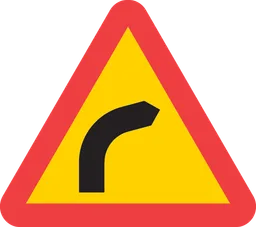
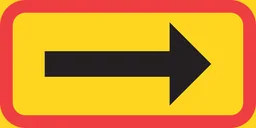
Dangerous curve, to the right
Swedish name: Varning för farlig kurva
The road sign warns of a dangerous curve, in this case a dangerous curve to the right. The curve is normally quite sharp and can be dangerous if you do not reduce the speed. The road sign is placed where it is inappropriate to follow the speed limit in the curve. In sharp curves, there is always a risk that an oncoming vehicle "cuts the curve" by driving in your lane where the curve is the sharpest. This can of course cause a very dangerous situation, especially if the view in the curve is obscured. In sharp curves with obscured visibility, you must also keep in mind that there may be children playing, pedestrians, animals or obstacles on the road just after the curve.
A2-1Warning Signs
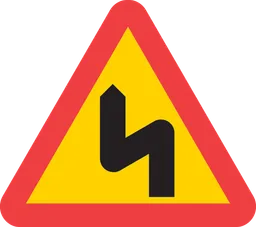
Multiple dangerous curves, first to the left
Swedish name: Varning för flera farliga kurvor
The road sign warns of several dangerous curves, in this case the first curve is to the left. The curves are normally quite sharp and can be dangerous if you do not reduce the speed. The road sign is placed where it is inappropriate to follow the speed limit in the curves. In sharp curves, there is always a risk that an oncoming vehicle "cuts the curve" by driving in your lane where the curve is the sharpest. This can of course cause a very dangerous situation, especially if the view in the curve is obscured. In sharp curves with obscured visibility, you must also keep in mind that there may be children playing, pedestrians, animals or obstacles on the road just after the curve.
A2-2Warning Signs
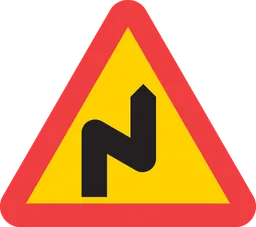
Multiple dangerous curves, first to the right
Swedish name: Varning för flera farliga kurvor
The road sign warns of several dangerous curves, in this case the first curve is to the right. The curves are normally quite sharp and can be dangerous if you do not reduce the speed. The road sign is placed where it is inappropriate to follow the speed limit in the curves. In sharp curves, there is always a risk that an oncoming vehicle "cuts the curve" by driving in your lane where the curve is the sharpest. This can of course cause a very dangerous situation, especially if the view in the curve is obscured. In sharp curves with obscured visibility, you must also keep in mind that there may be children playing, pedestrians, animals or obstacles on the road just after the curve.
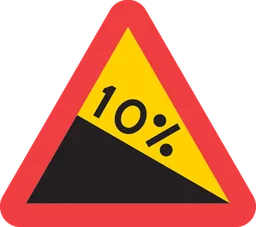
A3-1Warning Signs
Steep hill downwards
Swedish name: Varning för nedförslutning
The road sign indicates a steep hill downwards. The number indicates the slope in percent and is adapted to the conditions of the location.
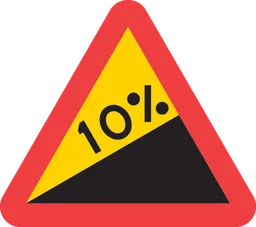
A4-1Warning Signs
Steep hill upwards
Swedish name: Varning för uppförslutning
The road sign indicates a steep hill upwards. The number indicates the slope in percent and is adapted to the conditions of the location.
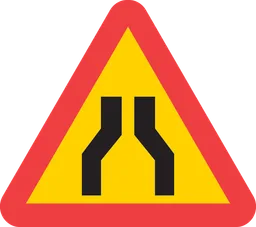
A5-1Warning Signs
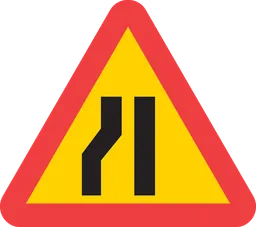
Road narrows, on both sides
Swedish name: Varning för avsmalnande väg
The road sign indicates that the road narrows, in this case on both sides. The symbol is adapted to the conditions of the location and shows whether the road narrows on both sides, only on the right side or only on the left side.
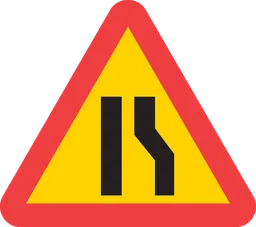
A5-2Warning Signs
Road narrows, on the right side
Swedish name: Varning för avsmalnande väg
The road sign indicates that the road narrows, in this case on the right side. The symbol is adapted to the conditions of the location and shows whether the road narrows on both sides, only on the right side or only on the left side.
A5-3Warning Signs
Road narrows, on the left side
Swedish name: Varning för avsmalnande väg
The road sign indicates that the road narrows, in this case on the left side. The symbol is adapted to the conditions of the location and shows whether the road narrows on both sides, only on the right side or only on the left side.
A6-1Warning Signs
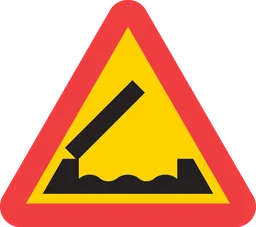
Opening or swing bridge
Swedish name: Varning för bro
The road sign warns that you are approaching an opening bridge. Bridge openings can take time, so it may be appropriate to turn off the engine while waiting. The risk of slipperiness is especially great on bridges and viaducts, as they are chilled from both below and above.
A7-1Warning Signs
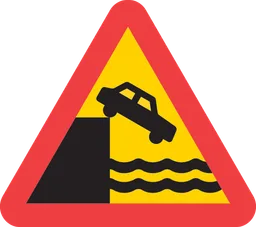
Quay
Swedish name: Varning för kaj
The road sign indicates that you are approaching a quay, a beach, a ferry or a harbour and that the road you are driving on ends towards water.
A8-1Warning Signs
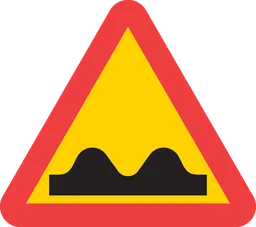
Uneven road
Swedish name: Varning för ojämn väg
The road sign warns that the road surface is in such poor condition that it is suitable to travel at a lower speed.
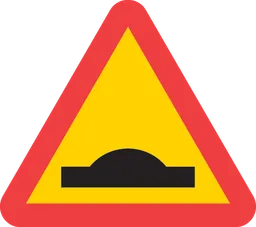
A9-1Warning Signs
Speed bump, raised
Swedish name: Varning för farthinder - Gupp
The road sign indicates that there will be one or more raised speed bumps on the road ahead of you. Always adapt the speed and ready yourself for action when you drive in areas with speed bumps – you are likely to meet pedestrians and children playing on or next to the road.
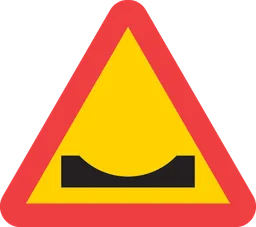
A9-2Warning Signs
Speed bump, lowered
Swedish name: Varning för farthinder - Grop
The road sign indicates that there will be one or more lowered speed bumps on the road ahead of you. Always adapt the speed and ready yourself for action when you drive in areas with speed bumps – you are likely to meet pedestrians and children playing on or next to the road.
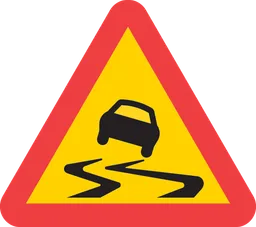
A10-1Warning Signs
Slippery road
Swedish name: Varning för slirig väg
The road sign indicates that the road may be slippery. The road sign is used in different places, but is most common before roadworks where new asphalt is laid. The road sign is normally not used to warn of a slippery surface due to snow or ice.
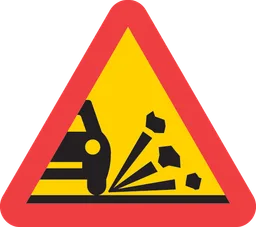
A11-1Warning Signs
Loose chippings
Swedish name: Varning för stenskott
The road sign indicates risk of loose chippings. The road sign is not used on gravel roads or similar roads where loose chippings are common.
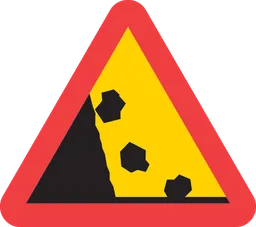
A12-2Warning Signs
Falling rocks
Swedish name: Varning för stenras
The road sign indicates risk of falling rocks and that rocks may occur on the road. The symbol is adapted to the conditions of the location.
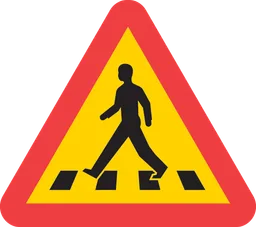
A13-1Warning Signs
Pedestrian crossing ahead
Swedish name: Varning för övergångsställe
The road sign warns of a pedestrian crossing further ahead. Note that this road sign is not always posted before pedestrian crossings.
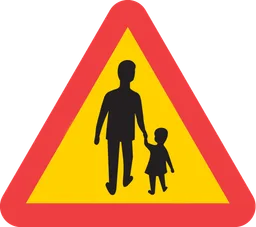
A14-1Warning Signs
Pedestrians ahead
Swedish name: Varning för gående
The road sign indicates a road section where pedestrians often cross or stay on or near the road.
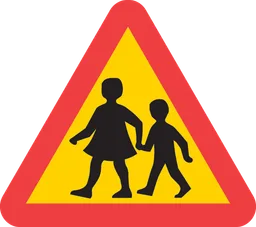
A15-1Warning Signs
Children ahead
Swedish name: Varning för barn
The road sign indicates a road section where children often cross or stay on or near the road. The road sign is common at schools and preschools but is also often posted at residential areas where children may be staying or playing near the road.
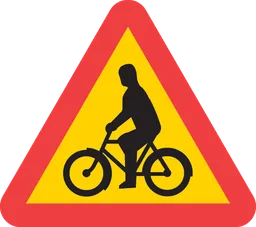
A16-1Warning Signs
Cyclists and moped riders on carriageway
Swedish name: Varning för cyklande och mopedförare
The road sign indicates a road section where cyclists or moped riders often cross or drive onto the road.
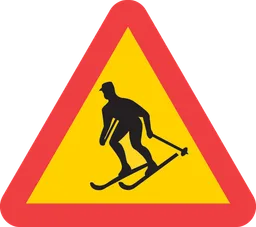
A17-1Warning Signs
Skiers ahead
Swedish name: Varning för skidåkare
The road sign indicates a road section where skiers often cross or stay on the road.
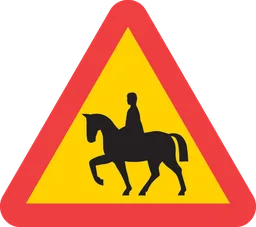
A18-1Warning Signs
Riders on horseback ahead
Swedish name: Varning för ridande
The road sign indicates a road section where riders on horseback often cross or stay on the road. When you encounter riders on horseback, you need to keep in mind that many horses scare easily and that the riders are often young people with little traffic experience.
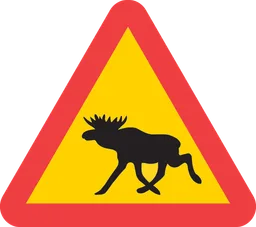
A19-1Warning Signs
Animals, elk
Swedish name: Varning för djur - Älg
The road sign indicates a place or road section where there is a particular risk for animals on or near the road, in this case the sign warns of elk. Other animal symbols may appear on the sign.
A20-1Warning Signs
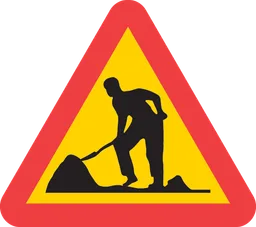
Roadworks
Swedish name: Varning för vägarbete
The road sign indicates a road section where roadworks or similar work is underway. At both major and minor roadworks, it is important that you show consideration for those who work on the road – always pass roadworks at an appropriate speed and with plenty of sideways clearance. Do not expect that you will be seen or heard as you approach or when you pass. On the other hand, expect that the road surface may be slippery, that a large vehicle may start to reverse without warning or that someone may suddenly step onto the road.
A21-1Warning Signs
End of roadworks
Swedish name: Slut på sträcka med vägarbete
The road sign indicates end of a road section with roadworks marked with the road sign "Roadworks". The road sign is not posted if it is obvious where the road section ends.
A22-1Warning Signs
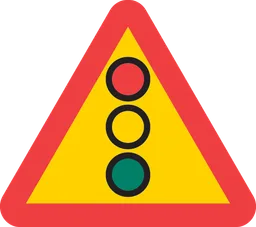
Traffic lights
Swedish name: Varning för flerfärgssignal (trafikljus)
The road sign warns of traffic lights further ahead. In densely built-up areas, the road sign is only posted if there is a special reason – it is not posted before all traffic lights.
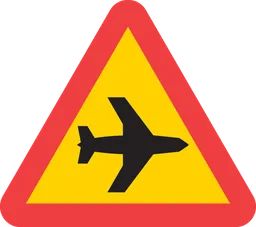
A23-1Warning Signs
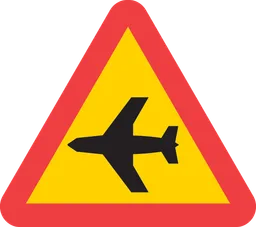
Low flying aircraft
Swedish name: Varning för lågt flygande flygplan
The road sign indicates an area where low flying aircraft are common. The symbol is adapted to the conditions of the location.
A23-2Warning Signs
Low flying aircraft
Swedish name: Varning för lågt flygande flygplan
The road sign indicates an area where low flying aircraft are common. The symbol is adapted to the conditions of the location.
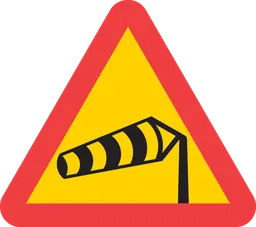
A24-1Warning Signs
Crosswinds, from the right
Swedish name: Varning för sidvind - Från höger
The road sign indicates a road section where there is often strong crosswind, in this case from the right. Crosswind can feel a little uncomfortable and for some larger vehicles, like caravans and trucks, they can also be dangerous.
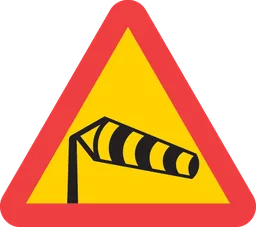
A24-2Warning Signs
Crosswinds, from the left
Swedish name: Varning för sidvind - Från vänster
The road sign indicates a road section where there is often strong crosswind, in this case from the left. Crosswind can feel a little uncomfortable and for some larger vehicles, like caravans and trucks, they can also be dangerous.
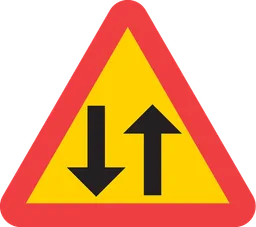
A25-1Warning Signs
Two-way traffic
Swedish name: Varning för mötande trafik
The road sign warns of oncoming traffic and indicates that a carriageway with one-way traffic is turning into a carriageway with traffic in both directions. The road sign is most common where a motorway or 2+1 road ends.
A26-1Warning Signs
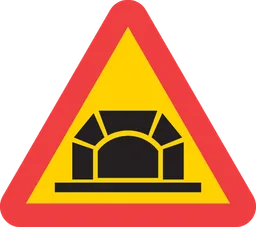
Tunnel
Swedish name: Varning för tunnel
The road sign indicates that the road will soon pass through a tunnel.
A27-1Warning Signs
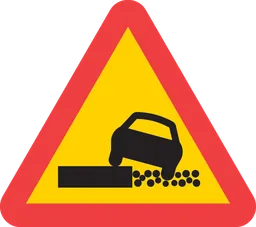
Soft verge or high carriageway edge
Swedish name: Varning för svag vägkant eller hög körbanekant
The road sign indicates a road section with a soft verge or high carriageway edge. A soft verge means that the risk of driving off the road increases, especially for heavy vehicles. If you accidentally drive off the road with two wheels, release the throttle and let the car slow down on its own. When appropriate, gently drive back onto the road again. Avoid braking hard and excessive steering as it can cause the car to skid.
A28-1Warning Signs
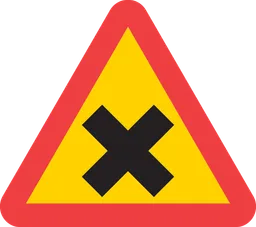
Junction
Swedish name: Varning för vägkorsning
The road sign warns of a junction ahead where the priority to the right rule applies. The road sign is most common on smaller roads, where the junction is obscured.
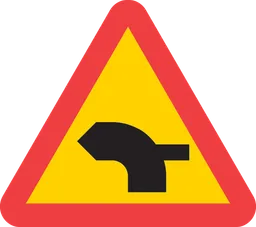
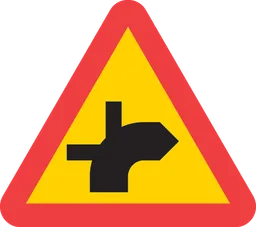
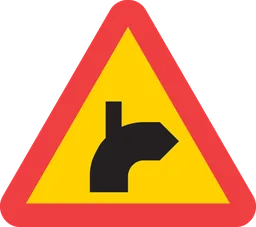
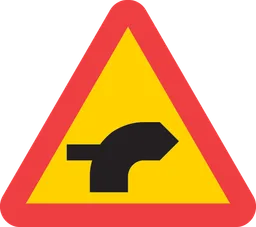
A29-1Warning Signs
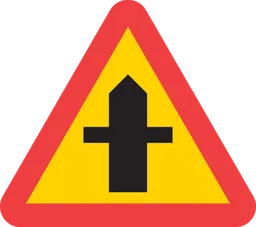
Junction where road users on connecting roads have a duty to give way or stop
Swedish name: Varning för vägkorsning där trafikanter på anslutande väg har väjningsplikt eller stopplikt
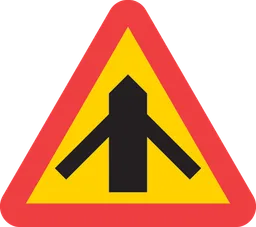
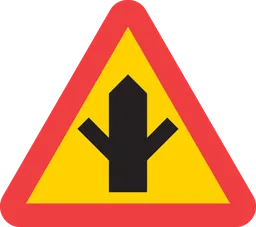
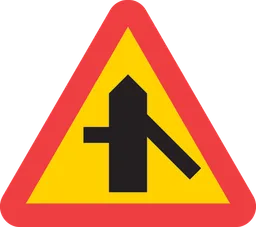
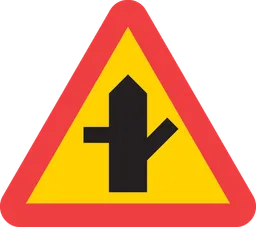
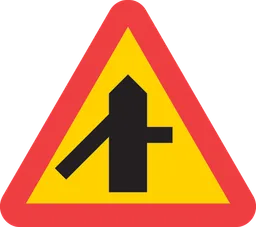
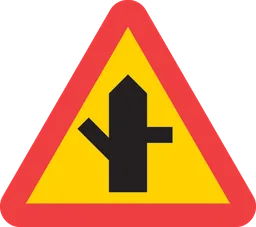
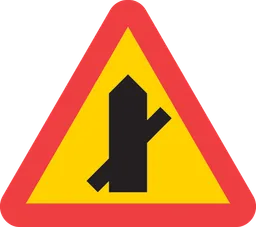
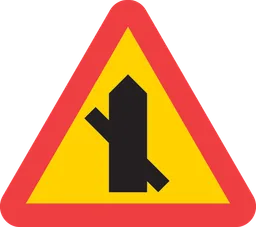
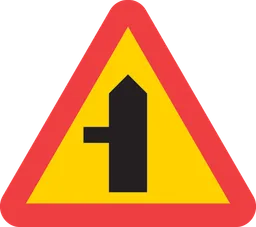
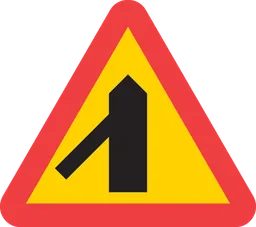
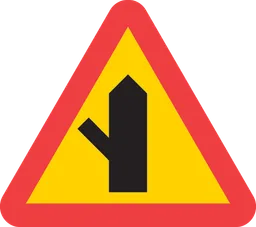
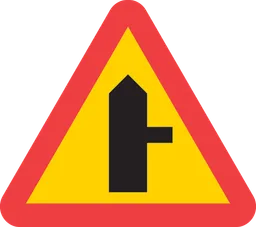
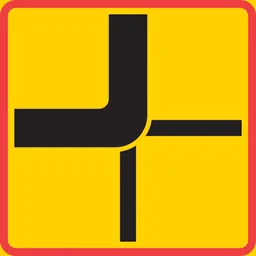
The road sign indicates a junction where road users on connecting roads have a duty to give way or stop at the junction. The symbol is adapted to the conditions of the location. The thick line refers to the road you are driving on and the other lines show how the junction is designed.
A29-2Warning Signs
Junction where road users on connecting roads have a duty to give way or stop
Swedish name: Varning för vägkorsning där trafikanter på anslutande väg har väjningsplikt eller stopplikt
The road sign indicates a junction where road users on connecting roads have a duty to give way or stop at the junction. The symbol is adapted to the conditions of the location. The thick line refers to the road you are driving on and the other lines show how the junction is designed.
A29-3Warning Signs
Junction where road users on connecting roads have a duty to give way or stop
Swedish name: Varning för vägkorsning där trafikanter på anslutande väg har väjningsplikt eller stopplikt
The road sign indicates a junction where road users on connecting roads have a duty to give way or stop at the junction. The symbol is adapted to the conditions of the location. The thick line refers to the road you are driving on and the other lines show how the junction is designed.
A29-4Warning Signs
Junction where road users on connecting roads have a duty to give way or stop
Swedish name: Varning för vägkorsning där trafikanter på anslutande väg har väjningsplikt eller stopplikt
The road sign indicates a junction where road users on connecting roads have a duty to give way or stop at the junction. The symbol is adapted to the conditions of the location. The thick line refers to the road you are driving on and the other lines show how the junction is designed.
A29-5Warning Signs
Junction where road users on connecting roads have a duty to give way or stop
Swedish name: Varning för vägkorsning där trafikanter på anslutande väg har väjningsplikt eller stopplikt
The road sign indicates a junction where road users on connecting roads have a duty to give way or stop at the junction. The symbol is adapted to the conditions of the location. The thick line refers to the road you are driving on and the other lines show how the junction is designed.
A29-6Warning Signs
Junction where road users on connecting roads have a duty to give way or stop
Swedish name: Varning för vägkorsning där trafikanter på anslutande väg har väjningsplikt eller stopplikt
The road sign indicates a junction where road users on connecting roads have a duty to give way or stop at the junction. The symbol is adapted to the conditions of the location. The thick line refers to the road you are driving on and the other lines show how the junction is designed.
A29-7Warning Signs
Junction where road users on connecting roads have a duty to give way or stop
Swedish name: Varning för vägkorsning där trafikanter på anslutande väg har väjningsplikt eller stopplikt
The road sign indicates a junction where road users on connecting roads have a duty to give way or stop at the junction. The symbol is adapted to the conditions of the location. The thick line refers to the road you are driving on and the other lines show how the junction is designed.
A29-8Warning Signs
Junction where road users on connecting roads have a duty to give way or stop
Swedish name: Varning för vägkorsning där trafikanter på anslutande väg har väjningsplikt eller stopplikt
The road sign indicates a junction where road users on connecting roads have a duty to give way or stop at the junction. The symbol is adapted to the conditions of the location. The thick line refers to the road you are driving on and the other lines show how the junction is designed.
A29-9Warning Signs
Junction where road users on connecting roads have a duty to give way or stop
Swedish name: Varning för vägkorsning där trafikanter på anslutande väg har väjningsplikt eller stopplikt
The road sign indicates a junction where road users on connecting roads have a duty to give way or stop at the junction. The symbol is adapted to the conditions of the location. The thick line refers to the road you are driving on and the other lines show how the junction is designed.
A29-10Warning Signs
Junction where road users on connecting roads have a duty to give way or stop
Swedish name: Varning för vägkorsning där trafikanter på anslutande väg har väjningsplikt eller stopplikt
The road sign indicates a junction where road users on the connecting road have a duty to give way or stop at the junction. The symbol is adapted to the conditions of the location. The thick line refers to the road you are driving on and the other lines show how the junction is designed.
A29-11Warning Signs
Junction where road users on connecting roads have a duty to give way or stop
Swedish name: Varning för vägkorsning där trafikanter på anslutande väg har väjningsplikt eller stopplikt
The road sign indicates a junction where road users on the connecting road have a duty to give way or stop at the junction. The symbol is adapted to the conditions of the location. The thick line refers to the road you are driving on and the other lines show how the junction is designed.
A29-12Warning Signs
Junction where road users on connecting roads have a duty to give way or stop
Swedish name: Varning för vägkorsning där trafikanter på anslutande väg har väjningsplikt eller stopplikt
The road sign indicates a junction where road users on the connecting road have a duty to give way or stop at the junction. The symbol is adapted to the conditions of the location. The thick line refers to the road you are driving on and the other lines show how the junction is designed.
A29-13Warning Signs
Junction where road users on connecting roads have a duty to give way or stop
Swedish name: Varning för vägkorsning där trafikanter på anslutande väg har väjningsplikt eller stopplikt
The road sign indicates a junction where road users on the connecting road have a duty to give way or stop at the junction. The symbol is adapted to the conditions of the location. The thick line refers to the road you are driving on and the other lines show how the junction is designed.
A29-14Warning Signs
Junction where road users on connecting roads have a duty to give way or stop
Swedish name: Varning för vägkorsning där trafikanter på anslutande väg har väjningsplikt eller stopplikt
The road sign indicates a junction where road users on the connecting road have a duty to give way or stop at the junction. The symbol is adapted to the conditions of the location. The thick line refers to the road you are driving on and the other lines show how the junction is designed.
A29-15Warning Signs
Junction where road users on connecting roads have a duty to give way or stop
Swedish name: Varning för vägkorsning där trafikanter på anslutande väg har väjningsplikt eller stopplikt
The road sign indicates a junction where road users on the connecting road have a duty to give way or stop at the junction. The symbol is adapted to the conditions of the location. The thick line refers to the road you are driving on and the other lines show how the junction is designed.
A29-16Warning Signs
Junction where road users on connecting roads have a duty to give way or stop
Swedish name: Varning för vägkorsning där trafikanter på anslutande väg har väjningsplikt eller stopplikt
The road sign indicates a junction where road users on connecting roads have a duty to give way or stop at the junction. The symbol is adapted to the conditions of the location. The thick line refers to the road you are driving on and the other lines show how the junction is designed.
A29-17Warning Signs
Junction where road users on connecting roads have a duty to give way or stop
Swedish name: Varning för vägkorsning där trafikanter på anslutande väg har väjningsplikt eller stopplikt
The road sign indicates a junction where road users on connecting roads have a duty to give way or stop at the junction. The symbol is adapted to the conditions of the location. The thick line refers to the road you are driving on and the other lines show how the junction is designed.
A29-18Warning Signs
Junction where road users on connecting roads have a duty to give way or stop
Swedish name: Varning för vägkorsning där trafikanter på anslutande väg har väjningsplikt eller stopplikt
The road sign indicates a junction where road users on the connecting road have a duty to give way or stop at the junction. The symbol is adapted to the conditions of the location. The thick line refers to the road you are driving on and the other lines show how the junction is designed.
A29-19Warning Signs
Junction where road users on connecting roads have a duty to give way or stop
Swedish name: Varning för vägkorsning där trafikanter på anslutande väg har väjningsplikt eller stopplikt
The road sign indicates a junction where road users on connecting roads have a duty to give way or stop at the junction. The symbol is adapted to the conditions of the location. The thick line refers to the road you are driving on and the other lines show how the junction is designed.
A29-20Warning Signs
Junction where road users on connecting roads have a duty to give way or stop
Swedish name: Varning för vägkorsning där trafikanter på anslutande väg har väjningsplikt eller stopplikt
The road sign indicates a junction where road users on the connecting road have a duty to give way or stop at the junction. The symbol is adapted to the conditions of the location. The thick line refers to the road you are driving on and the other lines show how the junction is designed.
A29-21Warning Signs
Junction where road users on connecting roads have a duty to give way or stop
Swedish name: Varning för vägkorsning där trafikanter på anslutande väg har väjningsplikt eller stopplikt
The road sign indicates a junction where road users on the connecting road have a duty to give way or stop at the junction. The symbol is adapted to the conditions of the location. The thick line refers to the road you are driving on and the other lines show how the junction is designed.
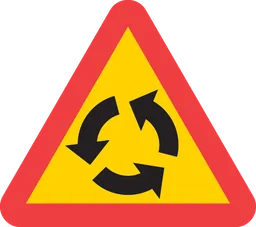
A30-1Warning Signs
Roundabout
Swedish name: Varning för cirkulationsplats
The road sign indicates that there is a roundabout ahead.
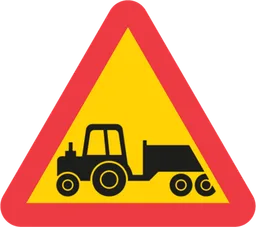
A31-1Warning Signs
Slow-moving vehicles
Swedish name: Varning för långsamtgående fordon
The road sign indicates a place where slow-moving vehicles often cross or drive onto the road.
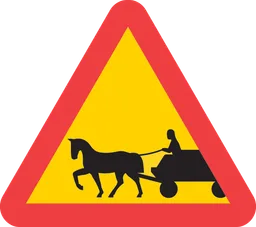
A32-1Warning Signs
Horse-drawn vehicles
Swedish name: Varning för fordon med förspänt dragdjur
The road sign indicates a place where horse-drawn vehicles often cross or drive onto the road.
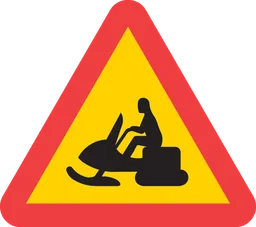
A33-1Warning Signs
Off-road snow scooters
Swedish name: Varning för terrängskotertrafik
The road sign indicates a place where off-road snow scooters often cross or drive onto the road.
A34-1Warning Signs
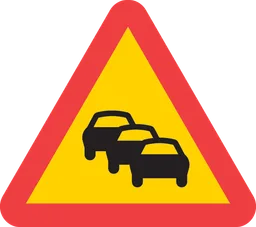
Traffic queues likely
Swedish name: Varning för kö
The road sign indicates a road section where there is a risk of queueing. The sign is mainly used as an adjustable (digital) road sign.
A35-1Warning Signs
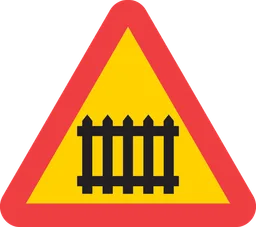
Level crossing with gates
Swedish name: Varning för järnvägskorsning med bommar
The road sign indicates a level crossing with gates. A level crossing is a junction with a railway or tramway line. Regardless of what type of safety device a level crossing is equipped with, you should never rely on it blindly – you must always check for approaching trains before passing the level crossing. Always look both left and right when checking.
A36-1Warning Signs
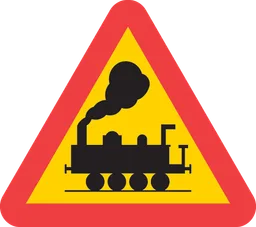
Level crossing without gates
Swedish name: Varning för järnvägskorsning utan bommar
The road sign indicates a level crossing without gates. A level crossing is a junction with a railway or tramway line. Regardless of what type of safety device a level crossing is equipped with, you should never rely on it blindly – you must always check for approaching trains before passing the level crossing. Always look both left and right when checking.
A37-1Warning Signs
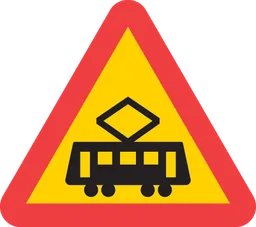
Junction with tramway line without gates
Swedish name: Varning för korsning med spårväg utan bommar
The road sign indicates a junction with a tramway line without gates. Regardless of what type of safety device a level crossing is equipped with, you should never rely on it blindly – you must always check for approaching trains before passing the level crossing. Always look both left and right when checking.
A38-1Warning Signs
Distance to level crossing, three-thirds distance
Swedish name: Avstånd till plankorsning - Tre tredjedels avstånd
The road sign indicates that there are three-thirds of the distance left to a level crossing. Further ahead you will pass a similar distance sign, though with two lines, and finally a distance sign with one line. Outside of densely built-up areas the distance sign is posted below one of the following warning signs: "Level crossing with gates", "Level crossing without gates" or "Junction with tramway line without gates".
A38-2Warning Signs
Distance to level crossing, two-thirds distance
Swedish name: Avstånd till plankorsning - Två tredjedels avstånd
The road sign indicates that there are two-thirds of the distance left to a level crossing. Further ahead you will pass a similar distance sign, though with one line.
A38-3Warning Signs
Distance to level crossing, one-third distance
Swedish name: Avstånd till plankorsning - En tredjedels avstånd
The road sign indicates that there is one-third of the distance left to a level crossing.
A39-1Warning Signs
Cross sign, one track
Swedish name: Kryssmärke - Ett spår
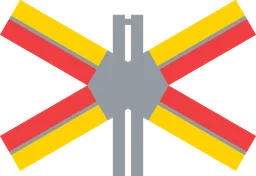
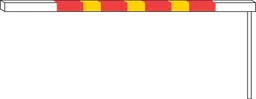
The road sign (it is called "Cross sign") indicates a junction with a railway or tramway line with one track. It is posted immediately prior to the level crossing. The road sign can also be designed with six (instead of four) yellow-red chevrons. It then indicates a level crossing with several tracks. The road sign does not have to be posted at private roads with limited traffic where it can be omitted without danger to traffic safety.
A39-2Warning Signs
Cross sign, one track
Swedish name: Kryssmärke - Ett spår
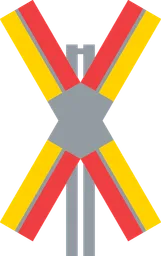
The road sign (it is called "Cross sign") indicates a junction with a railway or tramway line with one track. It is posted immediately prior to the level crossing. This long and narrow version is unusual and is only posted on very narrow or crooked roads. The road sign can also be designed with six (instead of four) yellow-red chevrons. It then indicates a level crossing with several tracks. The road sign does not have to be posted at private roads with limited traffic where it can be omitted without danger to traffic safety.
A39-3Warning Signs
Cross sign, several tracks
Swedish name: Kryssmärke - Flera spår
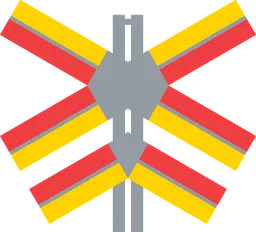
The road sign (it is called "Cross sign") indicates a junction with a railway or tramway line with several tracks. It is posted immediately prior to the level crossing. The road sign does not have to be posted at private roads with limited traffic where it can be omitted without danger to traffic safety.
A39-4Warning Signs
Cross sign, several tracks
Swedish name: Kryssmärke - Flera spår
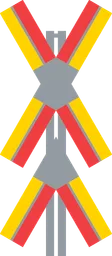
The road sign (it is called "Cross sign") indicates a junction with a railway or tramway line with several tracks. It is posted immediately prior to the level crossing. This long and narrow version is unusual and is only posted on very narrow or crooked roads. The road sign does not have to be posted at private roads with limited traffic where it can be omitted without danger to traffic safety.
A40-1Warning Signs
Other danger ahead
Swedish name: Varning för annan fara
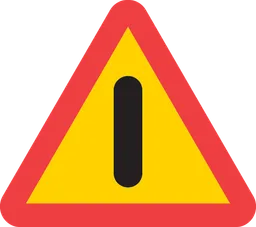
The road sign indicates a danger other than those which can be indicated by any other warning sign. The nature of the danger is specified on an additional panel.
A41-1Warning Signs
Accident
Swedish name: Varning för olycka
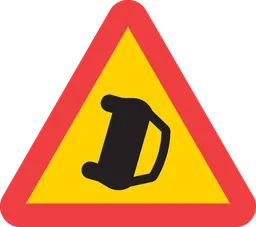
The road sign warn of an accident.
B1-1Priority Signs
Duty to give way
Swedish name: Väjningsplikt
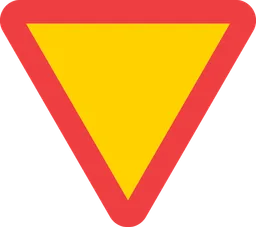
The road sign indicates that you have a duty to give way to vehicles on the intersecting road or route. At junctions with this road sign it is very important that you clearly communicate your intention to give way by slowing down well in advance, and if necessary, stopping completely. You may only proceed when you can do so without endangering or obstructing other road users. When you have a duty to give way you do not need to stop if there is not any traffic on the intersecting road. When you have a duty to stop, however, you must stop completely and give way before proceeding – regardless of whether there is any traffic on the intersecting road or not. Note that both police officers' signals and traffic signals apply before road signs. If you approach a junction and a police officer signals for you to continue, you must follow the officer's signal, even if the traffic light is red or there is a stop sign. You must still drive carefully and pay attention to other traffic.
B2-1Priority Signs
Duty to stop
Swedish name: Stopplikt
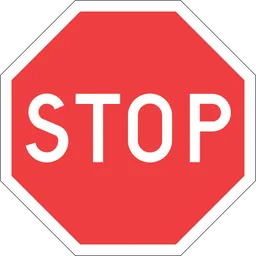
The road sign indicates that you have a duty to stop before entering the intersecting road, route or track area. If the road sign "Stop" is posted before a junction, you must stop completely and give way before proceeding. This applies regardless of whether there is any traffic on the intersecting road or not. The rules are designed in this way to ensure that drivers who have a duty to stop really do so and check traffic both ways before proceeding When you have a duty to stop, you should do so at the stop line or, if there is no line, just before, but not on, the intersecting road – where you can be clearly seen and have a clear view. You may only proceed when you can do so without endangering or obstructing other road users. Note that both police officers' signals and traffic signals apply before road signs. If you approach a junction and a police officer signals for you to continue, you must follow the officer's signal, even if the traffic light is red or there is a stop sign. You must still drive carefully and pay attention to other traffic.
B3-1Priority Signs
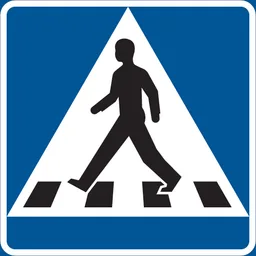
Pedestrian crossing
Swedish name: Övergångsställe
The road sign indicates that there is a pedestrian crossing further ahead. If the pedestrian crossing is unsupervised – that is, a pedestrian crossing that is not equipped with traffic signals – you must give way to pedestrians who have entered or are about to enter the pedestrian crossing.
B3-2Priority Signs
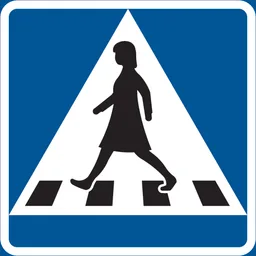
Pedestrian crossing
Swedish name: Övergångsställe
The road sign indicates that there is a pedestrian crossing further ahead. If the pedestrian crossing is unsupervised – that is, a pedestrian crossing that is not equipped with traffic signals – you must give way to pedestrians who have entered or are about to enter the pedestrian crossing.
B4-1Priority Signs
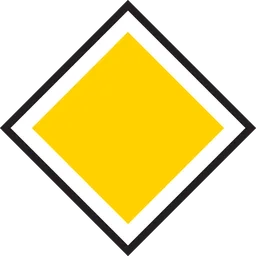
Priority road
Swedish name: Huvudled
The road sign indicates that the road is a priority road. A priority road is a road whose users are to be given priority by those on connecting and intersecting roads. Road users that are about to enter the priority road are informed of their duty to give way by road signs and, in most cases, road markings. The road sign is placed where the priority road begins and is repeated after each junction, unless it is already clear that the priority road continues. The priority road normally ends at a junction where give way or stop applies towards crossing traffic, but it can also end between junctions – in that case, the cancellation sign "End of priority road" is used. The priority road also ends where a motorway or clearway begins. There is a general parking prohibition on priority roads, which means that you are only allowed to park in marked parking spaces. There is, however, no general stopping prohibition on priority roads, which means that you are allowed to stop to load or unload goods, to allow a passenger to get in or out of the car, to avoid danger (for example, if an animals runs across the road) or if traffic conditions so require (for example, if there is a traffic jam).
B5-1Priority Signs
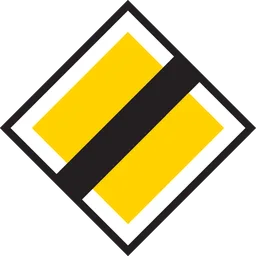
End of priority road
Swedish name: Huvudled upphör
The road sign indicates that the priority road ends. When the priority road ends, the priority to the right rule applies at upcoming junctions, unless otherwise indicated by another road sign or traffic signal. This sign is mainly used when the priority road ends between junctions, or in situations where there may be uncertainty about which traffic rules apply. If the priority road ends at a junction where you already have a duty to give way or stop, the sign does not need to be placed. After passing the sign, you should no longer assume you have the right of way and must be prepared to give way to traffic coming from the right, unless otherwise indicated.
B6-1Priority Signs
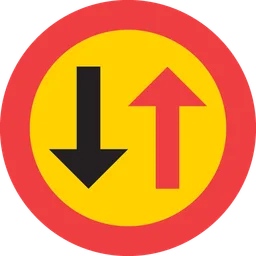
Priority for oncoming vehicles
Swedish name: Väjningsplikt mot mötande trafik
The road sign indicates that you have a duty to give way when meeting an oncoming vehicle. The road sign is most common in places where the road is narrow.
B7-1Priority Signs
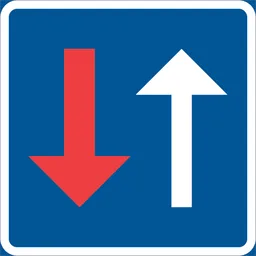
Priority over oncoming vehicles
Swedish name: Mötande trafik har väjningsplikt
The road sign indicates that oncoming traffic has a duty to give way.
B8-1Priority Signs
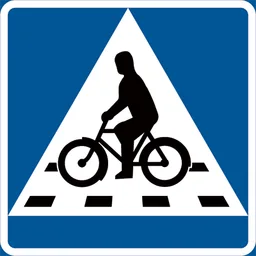
Cycle crossing
Swedish name: Cykelöverfart
The road sign indicates that there is a cycle crossing further ahead. A cycle crossing is a kind of pedestrian crossing for cyclists and riders of class 2 mopeds, where they can cross the road more safely. When you are about to cross an unsupervised cycle crossing you have a duty to give way to cyclists and moped riders who are on or about to enter the cycle crossing.
C1-1Prohibitory Signs
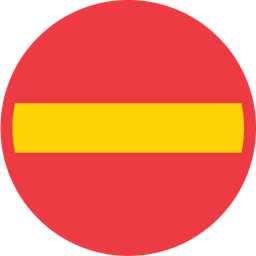
No entry
Swedish name: Förbud mot infart med fordon
The road sign prohibits entry with all vehicles. It is not allowed to drive or reverse into a road with this road sign. The road sign only applies in one direction, while the similar road sign "No vehicles" applies in both directions. The road sign does not apply to vehicles with permits. No entry (red circle with yellow line) – Prohibits entry with all vehicles. Is used where traffic only goes in one direction. No vehicles (red circle with smaller yellow circle inside) – Prohibits all vehicle traffic in both directions.
C2-1Prohibitory Signs
No vehicles
Swedish name: Förbud mot trafik med fordon
The road sign prohibits all vehicle traffic in both directions, while the similar road sign "No entry" only applies in one direction. The road sign does not apply to vehicles with permits. No vehicles (red circle with smaller yellow circle inside) – Prohibits all vehicle traffic in both directions. No entry (red circle with yellow line) – Prohibits entry with all vehicles. Is used where traffic only goes in one direction.
C3-1Prohibitory Signs
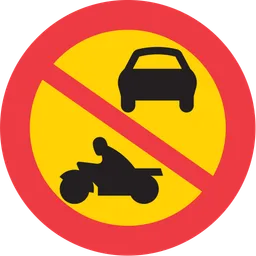
No motor vehicles except moped class 2
Swedish name: Förbud mot trafik med annat motordrivet fordon än moped klass 2
The road sign prohibits traffic by all motor vehicles except moped class 2. If the prohibition also applies to class 2 moped, this is indicated on an additional panel.
C4-1Prohibitory Signs
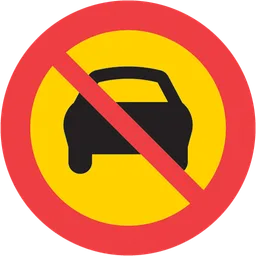
No motor vehicles with more than two wheels
Swedish name: Förbud mot trafik med motordrivet fordon med fler än två hjul
The road sign prohibits traffic with all types of motor vehicles with more than two wheels. Cars are not allowed to pass the road sign but motorcycles and other two-wheeled vehicles are. The road sign is normally found before roads and road sections that are so narrow that a car cannot pass.
C5-1Prohibitory Signs
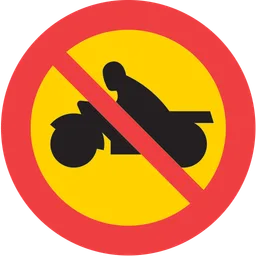
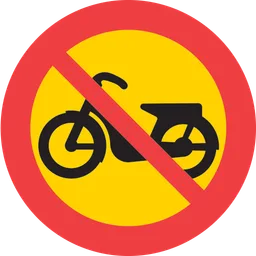
No motorcycles or class 1 mopeds
Swedish name: Förbud mot trafik med motorcykel och moped klass 1
The road sign prohibits traffic with motorcycles and class 1 mopeds. The road sign is usually posted in places where the aim is to reduce the noise level (motorcycles usually make more noise than cars).
C6-1Prohibitory Signs
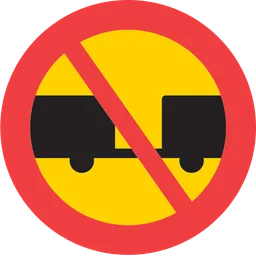
No motor vehicles with connected trailers
Swedish name: Förbud mot trafik med motordrivet fordon med tillkopplad släpvagn
The road sign prohibits traffic with motor vehicles with connected trailers. The prohibition does not apply to semi-trailers or centre axle trailers.
C7-1Prohibitory Signs
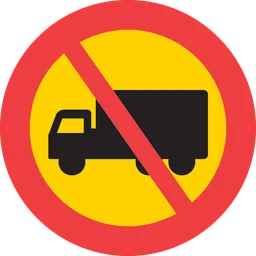
No heavy trucks
Swedish name: Förbud mot trafik med tung lastbil
The road sign prohibits traffic with heavy trucks (truck exceeding 3.5 tonnes total weight). The road sign is usually posted on smaller roads where heavy traffic is considered unsuitable. If the prohibition also applies to light trucks, this is indicated on an additional panel.
C8-1Prohibitory Signs
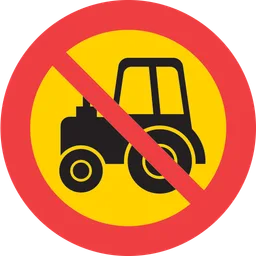
No tractors or motorised equipment class 2
Swedish name: Förbud mot trafik med traktor och motorredskap klass 2
The road sign prohibits traffic with tractors and motorised equipment class 1. The road sign is usually posted on major roads where traffic with slow-moving vehicles is considered unsuitable. If the prohibition also applies to motorised equipment class 1, this is indicated on an additional panel.
C9-1Prohibitory Signs
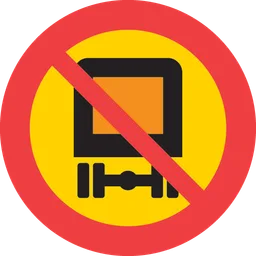
No vehicles carrying dangerous goods
Swedish name: Förbud mot trafik med fordon lastat med farligt gods
The road sign prohibits traffic with vehicles carrying dangerous goods. The road sign is posted in certain tunnels and on some roads in cities where an accident involving dangerous goods can become catastrophic.
C10-1Prohibitory Signs
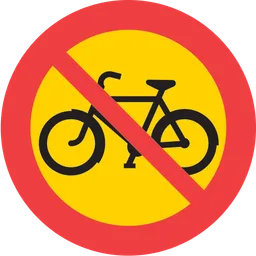
No cycles or class 2 mopeds
Swedish name: Förbud mot trafik med cykel och moped klass 2
The road sign prohibits traffic with cycles or class 2 mopeds. If the prohibition also applies to class 1 mopeds (EU-moped), this is indicated on an additional panel.
C11-1Prohibitory Signs
No class 2 mopeds
Swedish name: Förbud mot trafik med moped klass 2
The road sign prohibits traffic with class 2 mopeds. If the prohibition also applies to class 1 mopeds (EU-moped), this is indicated on an additional panel.
C12-1Prohibitory Signs
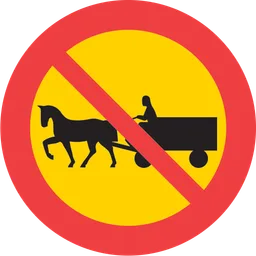
No horse-drawn vehicles
Swedish name: Förbud mot trafik med fordon förspänt med dragdjur
The road sign prohibits traffic with horse-drawn vehicles.
C13-1Prohibitory Signs
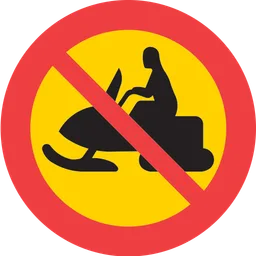
No off-road motor vehicles or off-road trailers
Swedish name: Förbud mot trafik med terrängmotorfordon och terrängsläp
The road sign prohibits traffic with off-road motor vehicles and off-road trailers.
C14-1Prohibitory Signs
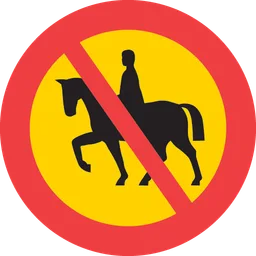
No riding
Swedish name: Förbud mot ridning
The road sign prohibits horse riding. If it is also prohibited to lead horses, this is indicated on an additional panel.
C15-1Prohibitory Signs
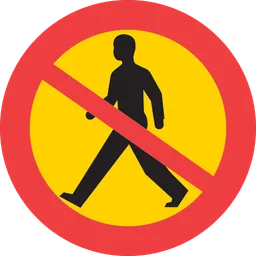
No pedestrians
Swedish name: Förbud mot gångtrafik
The road sign prohibits pedestrian traffic. The road sign is usually posted on major roads where pedestrian traffic is unsuitable.
C16-1Prohibitory Signs
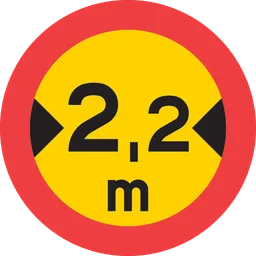
Restricted vehicle width
Swedish name: Begränsad fordonsbredd
The road sign prohibits traffic with vehicles over a certain width (excluding rear-view mirrors). In this case it is 2.2 metres. The road sign is common at roadworks on motorways where all traffic is moved to temporary, narrow lanes on one side of the road.
C17-1Prohibitory Signs
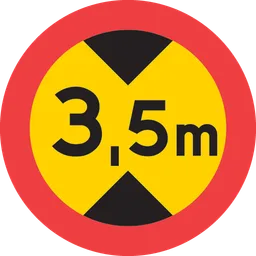
Restricted vehicle height
Swedish name: Begränsad fordonshöjd
The road sign prohibits traffic with vehicles over a certain height. In this case it is 3.5 metres. Roads in Sweden normally have a clearance of at least 4.5 metres. If the clearance in an underpass or similar is less than 4.5 metres, it is marked with this road sign.
C18-1Prohibitory Signs
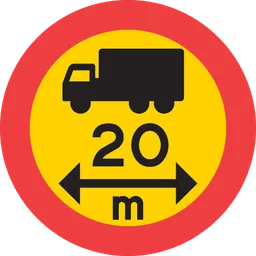
Restricted vehicle length
Swedish name: Begränsad fordonslängd
The road sign prohibits traffic with vehicles and combinations of vehicles over a certain length. In this case it is 20 metres. The road sign is uncommon in Sweden, but is posted on some serpentine roads with very sharp curves, and in some cities with narrow streets.
C19-1Prohibitory Signs
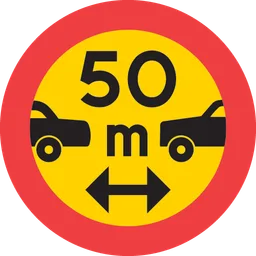
Minimum distance between motor vehicles
Swedish name: Minsta avstånd
The road sign prohibits keeping a shorter distance to the motor vehicle in front than the distance indicated on the road sign. The road sign is very uncommon and in Sweden it is almost only found in upper Norrland on ice roads (roads over frozen lakes) during the winter. The road sign can also be posted on bridges, but it is very uncommon.
C20-1Prohibitory Signs
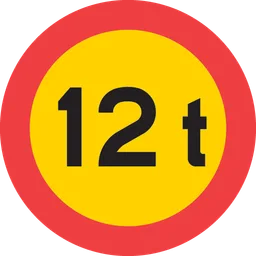
Restricted gross weight on vehicles
Swedish name: Begränsad bruttovikt på fordon
The road sign prohibits traffic with vehicles over a certain gross weight. In this case it is 12 tonnes. The gross weight of the towing vehicle and any trailer is calculated separately. Gross weight is the actual weight of the vehicle or the trailer at a certain moment. This means the gross weight varies depending on load and equipment. In practice, it is only drivers of heavy vehicles who have to take this road sign into account.
C21-1Prohibitory Signs
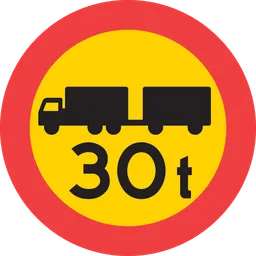
Restricted gross weight on vehicles and combinations of vehicles
Swedish name: Begränsad bruttovikt på fordon och fordonståg
The road sign prohibits traffic with vehicles or combinations of vehicles over a certain gross weight. In this case it is 30 tonnes. The gross weight of the towing vehicle and any trailer should be added together. Gross weight is the actual weight of the vehicle or the trailer at a certain moment. This means the gross weight varies depending on load and equipment. In practice, it is only drivers of heavy vehicles who have to take this road sign into account.
C22-1Prohibitory Signs
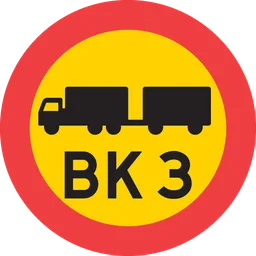
Bearing capacity class, BK 3
Swedish name: Bärighetsklass - BK 3
The road sign prohibits traffic with vehicles not allowed to drive on roads with bearing capacity class 3. Bearing capacity class (BK) is the classification used by Trafikverket to grade bearing capacity, that is, how much load a bridge or a road can handle. In practice, it is only drivers of heavy vehicles (e.g. truck or bus) who have to take this road sign into account.
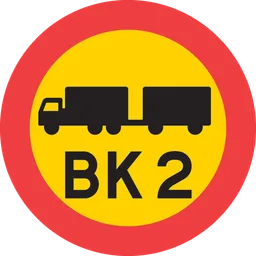
C22-2Prohibitory Signs
Bearing capacity class, BK 2
Swedish name: Bärighetsklass - BK 2
The road sign prohibits traffic with vehicles not allowed to drive on roads with bearing capacity class 2. Bearing capacity class (BK) is the classification used by Trafikverket to grade bearing capacity, that is, how much load a bridge or a road can handle. In practice, it is only drivers of heavy vehicles (e.g. truck or bus) who have to take this road sign into account.
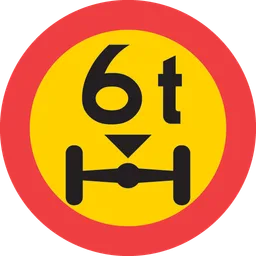
C23-1Prohibitory Signs
Restricted axle load
Swedish name: Begränsat axeltryck
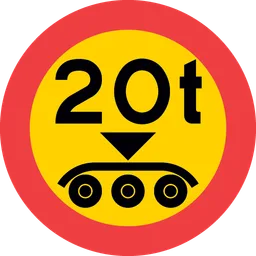
The road sign prohibits traffic with vehicles with an axle load exceeding the limit indicated on the road sign. In this case it is 6 tonnes. The axle load (sometimes called "weight on one axle") is the weight which the wheels of a wheel axle transfer to the road. In practice, it is only drivers of heavy vehicles who have to take this road sign into account.
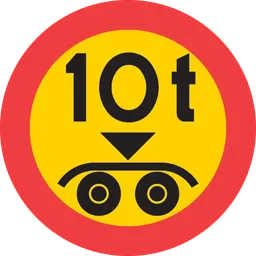
C24-1Prohibitory Signs
Restricted bogie load
Swedish name: Begränsat boggitryck
The road sign prohibits traffic with vehicles with a bogie load exceeding the limit indicated on the road sign. In this case it is 10 tonnes. The bogie load (sometimes called "weight on tandem axle") is the weight which the wheels of a bogie (a vehicle with wheel pairs that are less than 2 metres apart) transfer to the road. In practice, it is only drivers of heavy vehicles (e.g. truck or bus) who have to take this road sign into account.
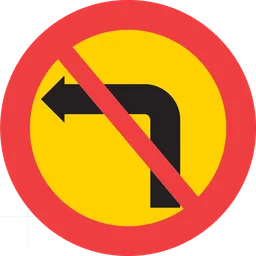
C25-1Prohibitory Signs
No left turn
Swedish name: Förbud mot sväng i korsning
The road sign prohibits left turns. The prohibition applies to the junction or equivalent where the road sign is posted. The prohibition may apply to several junctions. When this is the case the distance where the prohibition applies is indicated on an additional panel.
C25-2Prohibitory Signs
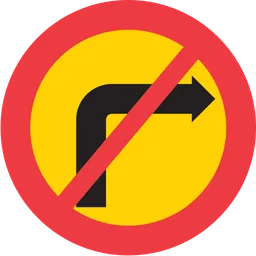
No right turn
Swedish name: Förbud mot sväng i korsning
The road sign prohibits right turns. The prohibition applies to the junction or equivalent where the road sign is posted. The prohibition may apply to several junctions. When this is the case the distance where the prohibition applies is indicated on an additional panel.
C26-1Prohibitory Signs
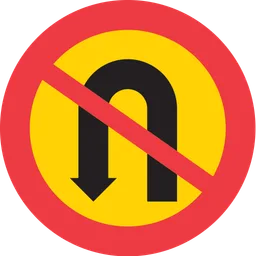
No U-turn
Swedish name: Förbud mot U-sväng
The road sign prohibits U-turns. The prohibition applies to the junction or equivalent where the road sign is posted. The prohibition may apply to several junctions. When this is the case the distance where the prohibition applies is indicated on an additional panel.
C27-1Prohibitory Signs
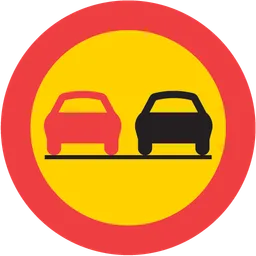
No overtaking
Swedish name: Omkörning förbjuden
The road sign prohibits overtaking motor vehicles with more than two wheels. You may still overtake two-wheeled mopeds and motorcycles, but not tricycles, quad bikes or motorcycles with sidecars. The road sign is sometimes supplemented with an additional panel which states that you can overtake a certain type of vehicle, usually tractors and motorised equipment. The prohibition applies on the road where the road sign is posted, until the cancelling sign "End of overtaking restriction".
C28-1Prohibitory Signs
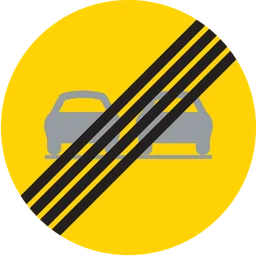
End of overtaking restriction
Swedish name: Slut på förbud mot omkörning
The road sign indicates that the overtaking restriction ends.
C29-1Prohibitory Signs
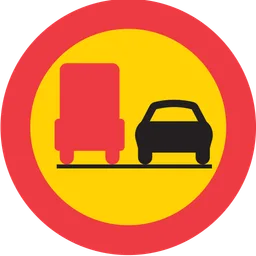
No overtaking by heavy trucks
Swedish name: Förbud mot omkörning med tung lastbil
The road sign prohibits heavy trucks from overtaking motor vehicles with more than two wheels. The prohibition applies on the road where the road sign is posted, until the cancelling sign "End of overtaking by heavy trucks restriction".
C30-1Prohibitory Signs
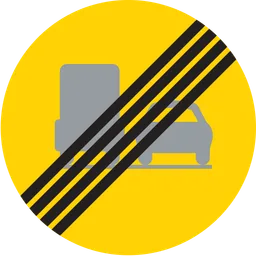
End of overtaking by heavy trucks restriction
Swedish name: Slut på förbud mot omkörning med tung lastbil
The road sign indicates that the overtaking by heavy trucks restriction ends.
C31-9Prohibitory Signs
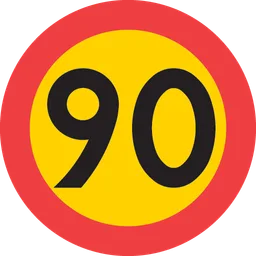
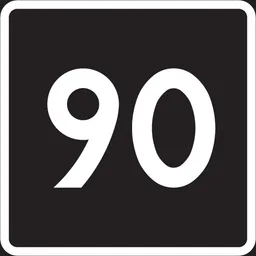
Maximum speed limit
Swedish name: Hastighetsbegränsning - 90 km/h
The road sign indicates that it is prohibited to exceed the speed indicated on the sign. In this case it is 90 km/h. The indication applies until a new speed limit is specified, or until the road sign "Temporary speed limit ends", "Pedestrian zone" or "Residential area".
C32-2Prohibitory Signs
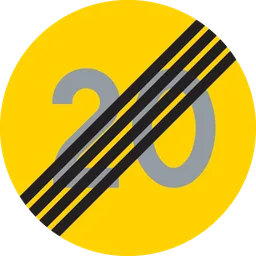
Temporary speed limit ends
Swedish name: Tillfällig hastighetsbegränsning upphör - 20 km/h
The road sign indicates that a temporary speed limit, usually due to roadworks, has ended. After the sign, the speed that applied before the temporary limit applies again.
C33-1Prohibitory Signs
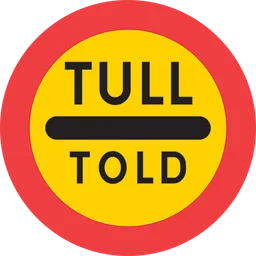
Stop at customs – Denmark
Swedish name: Stopp vid tull - Danmark
The road sign indicates the obligation to stop for customs clearance. You must stop at a stop line or, if there is no stop line, at the road sign. The text below the horizontal line is indicated in the appropriate language. In this case in Danish.
C33-2Prohibitory Signs
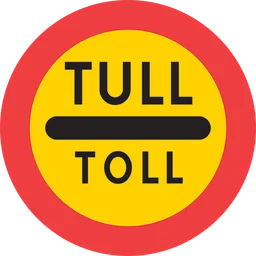
Stop at customs – Norway
Swedish name: Stopp vid tull - Norge
The road sign indicates the obligation to stop for customs clearance. You must stop at a stop line or, if there is no stop line, at the road sign. The text below the horizontal line is indicated in the appropriate language. In this case in Norwegian.
C33-3Prohibitory Signs
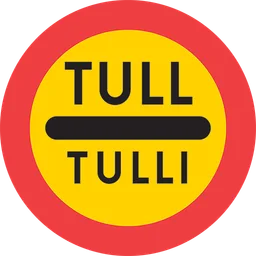
Stop at customs – Finland
Swedish name: Stopp vid tull - Finland
The road sign indicates the obligation to stop for customs clearance. You must stop at a stop line or, if there is no stop line, at the road sign. The text below the horizontal line is indicated in the appropriate language. In this case in Finnish.
C33-4Prohibitory Signs
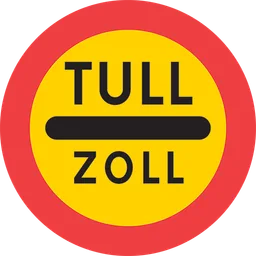
Stop at customs – Germany
Swedish name: Stopp vid tull - Tyskland
The road sign indicates the obligation to stop for customs clearance. You must stop at a stop line or, if there is no stop line, at the road sign. The text below the horizontal line is indicated in the appropriate language. In this case in German.
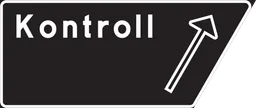
C34-1Prohibitory Signs
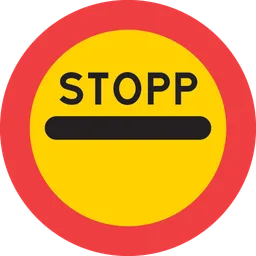
Stop for stated purpose
Swedish name: Stopp för angivet ändamål
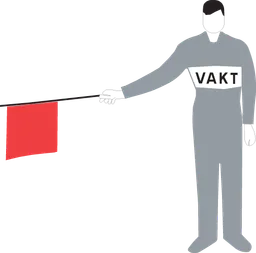
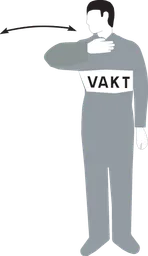
The road sign indicates the obligation to stop for the purpose stated below the horizontal line. For example: "Signal" (signal), "Färja" (ferry), "Kontroll" (checkpoint) or "Vakt" (guard). You must stop at a stop line or, if there is no stop line, at the road sign.
C34-2Prohibitory Signs
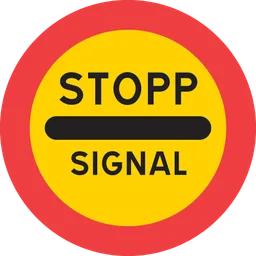
Stop for signal
Swedish name: Stopp för signal
The road sign indicates that drivers intending to pass the signal (traffic light) must stop when the light is red. However, if you are going to turn at the junction, before the signal, you may continue even if the light is red.
C35-1Prohibitory Signs
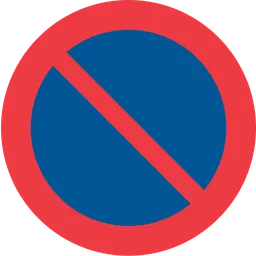
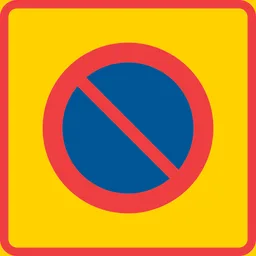
No parking
Swedish name: Förbud mot att parkera fordon
The road sign indicates that parking is prohibited on the side of the road where the sign is placed. Additional panels may limit the prohibition to only apply to certain types of vehicles, certain times of day or certain days. The prohibition applies from the sign to the next junction unless otherwise stated. Where parking is prohibited, you must never park and only stop to load or unload goods or to allow a passenger to get in or out of the car. Stopping is also allowed if it is necessary to avoid danger or if traffic conditions so require.
C36-1Prohibitory Signs
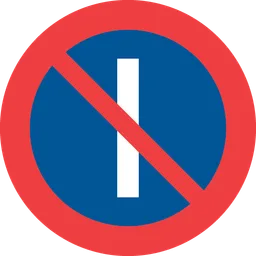
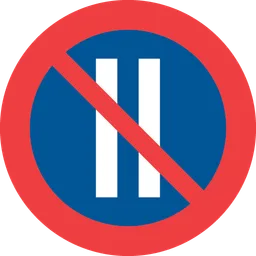
Parking is prohibited on odd number dates
Swedish name: Förbud mot att parkera fordon på dag med udda datum
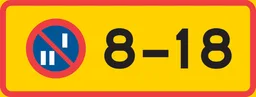
The road sign indicates that parking is prohibited on odd number dates on the side of the road where the sign is placed. This means that you are only allowed to park after the sign on even number dates The prohibition applies from the sign to the next junction unless otherwise stated. One white line – Parking is prohibited on odd number dates. Two white lines – Parking is prohibited on even number dates. Remembering what the road sign means will be easier if you keep in mind that two (II) is an even number. Where parking is prohibited, you must never park and only stop to load or unload goods or to allow a passenger to get in or out of the car. Stopping is also allowed if it is necessary to avoid danger or if traffic conditions so require.
C37-1Prohibitory Signs
Parking is prohibited on even number dates
Swedish name: Förbud mot att parkera fordon på dag med jämnt datum
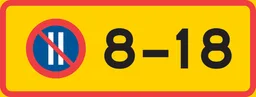
The road sign indicates that parking is prohibited on even number dates on the side of the road where the sign is placed. This means that you are only allowed to park after the sign on odd number dates The prohibition applies from the sign to the next junction unless otherwise stated. One white line – Parking is prohibited on odd number dates. Two white lines – Parking is prohibited on even number dates. Remembering what the road sign means will be easier if you keep in mind that two (II) is an even number. Where parking is prohibited, you must never park and only stop to load or unload goods or to allow a passenger to get in or out of the car. Stopping is also allowed if it is necessary to avoid danger or if traffic conditions so require.
C38-1Prohibitory Signs
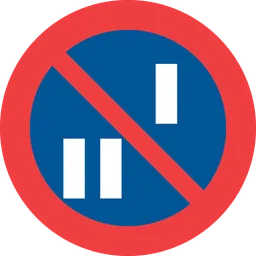
Alternate side parking
Swedish name: Datumparkering
The road sign indicates that parking restrictions are regulated by the date. On even number dates it is prohibited to park on the side of the road with even numbers. On odd number dates it is prohibited to park on the side of the road with odd numbers. These special parking rules are called alternate side parking (also known as date-zone parking) and are designed to facilitate snow clearing, street cleaning and sanding, which usually takes place at night. If alternate side parking applies and it is an even number date you must park on the side of the road with odd numbers. If it is an odd number date you must park on the side of the road with even numbers. An additional panel may limit the parking prohibition to certain times, for example from 0:00 until 06:00. When this is the case, it is allowed to park on both sides of the road during the rest of the day. If the alternate side parking is not limited to a certain time you must remember to move your car before midnight so as not to risk a parking fine. Keep in mind that an odd number date is sometimes followed by another odd number date, such as March 31 which is followed by April 1.
C39-1Prohibitory Signs
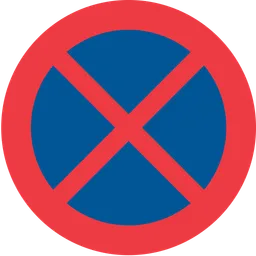
No stopping or parking
Swedish name: Förbud mot att stanna och parkera fordon
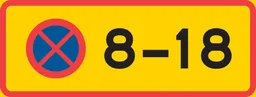
The road sign indicates that both stopping and parking is prohibited on the side of the road where the sign is placed. The prohibition applies from the sign to the next junction unless otherwise stated. Where stopping is prohibited, you must never stop unless it is necessary to avoid danger or if traffic conditions so require.
C40-1Prohibitory Signs
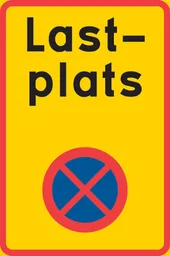
Location of purpose, loading place
Swedish name: Ändamålsplats - Lastplats
The road sign indicates that it is prohibited to stop and park for any other purpose than the one specified. In this case, only vehicles used for goods deliveries may stop when making a delivery. If only a certain type of vehicle or a group of road users is allowed to stop, this is indicated on an additional panel.
C40-2Prohibitory Signs
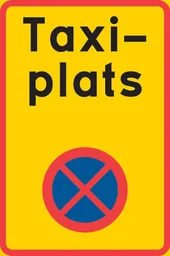
Location of purpose, taxi
Swedish name: Ändamålsplats - Taxiplats
The road sign indicates that it is prohibited to stop and park for any other purpose than the one specified. In this case, only taxi vehicles are allowed to stop while waiting for the next customer. If only a certain type of vehicle or a group of road users is allowed to stop, this is indicated on an additional panel.
C40-6Prohibitory Signs
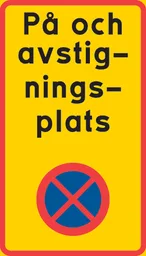
Location of purpose, boarding and alighting point
Swedish name: Ändamålsplats - På och avstigningsplats
The road sign indicates that it is prohibited to stop and park for any other purpose than the one specified. In this case, it is only allowed to stop to let a passenger get in or out of the car. If only a certain type of vehicle or a group of road users is allowed to stop, this is indicated on an additional panel.
C41-1Prohibitory Signs
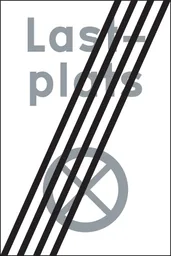
End of location of purpose, loading place
Swedish name: Slut på ändamålsplats - Lastplats
The road sign indicates that the location of purpose ends. The road sign does not need to be posted if it is clear that the location of purpose ends.
C41-2Prohibitory Signs
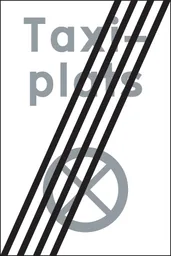
End of location of purpose, taxi
Swedish name: Slut på ändamålsplats - Taxiplats
The road sign indicates that the location of purpose ends. The road sign does not need to be posted if it is clear that the location of purpose ends.
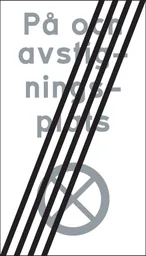
C41-6Prohibitory Signs
End of location of purpose, boarding and alighting point
Swedish name: Slut på ändamålsplats - På och avstigningsplats
The road sign indicates that the location of purpose ends. The road sign does not need to be posted if it is clear that the location of purpose ends.
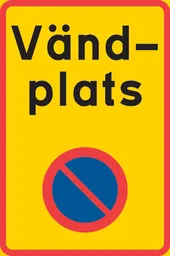
C42-1Prohibitory Signs
Turning area, no parking
Swedish name: Vändplats
The road sign indicates an area intended for turning and that parking is prohibited. Since stopping is not prohibited you are allowed to stop to load or unload goods or to allow a passenger to get in or out of the car.
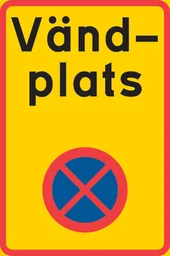
C42-2Prohibitory Signs
Turning area, no parking or stopping
Swedish name: Vändplats
The road sign indicates an area intended for turning and that both stopping and parking is prohibited.
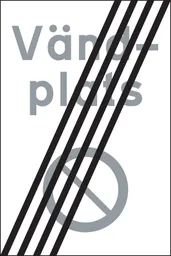
C43-1Prohibitory Signs
End of turning area, no parking
Swedish name: Slut på vändplats
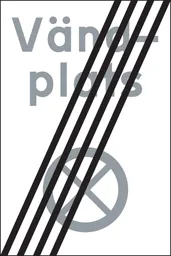
The road sign indicates that the turning area ends. The road sign does not need to be posted if it is clear that the turning area ends.
C43-2Prohibitory Signs
End of turning area, no parking or stopping
Swedish name: Slut på vändplats
The road sign indicates that the turning area ends. The road sign does not need to be posted if it is clear that the turning area ends.
C44-1Prohibitory Signs
No motor vehicles with studded tyres other than moped class 2
Swedish name: Förbud mot trafik med annat motordrivet fordon med dubbdäck än moped klass 2
The road sign prohibits traffic with other motor vehicles with studded tyres than class 2 mopeds. The road sign was introduced in 2010 to reduce the levels of hazardous particles in the air (studded tyres tear up the asphalt and generate airborne particles that are harmful to health).
C46-1Prohibitory Signs
Restricted triple axle load
Swedish name: Begränsat trippelaxeltryck
The road sign prohibits traffic with vehicles with a tripple axle load exceeding the limit indicated on the road sign. In this case it is 20 tonnes. The triple axle load is the weight which the wheels of a triple axle transfer to the road. In practice, it is only drivers of heavy vehicles who have to take this road sign into account.
D1-1Mandatory Signs
Direction to be followed, left only
Swedish name: Påbjuden körriktning - Vänster
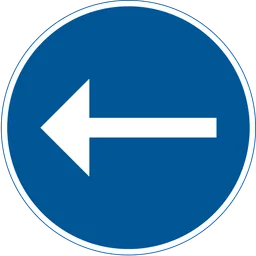
The road sign indicates that you must drive in the direction of the arrow. In this case, you must drive to the left. The road sign is used where there are other possible directions you are not allowed to choose.
D1-2Mandatory Signs
Direction to be followed, right only
Swedish name: Påbjuden körriktning - Höger
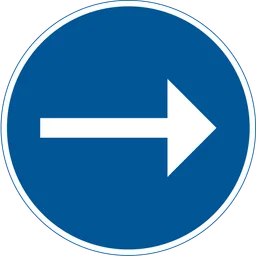
The road sign indicates that you must drive in the direction of the arrow. In this case, you must drive to the right. The road sign is used where there are other possible directions you are not allowed to choose.
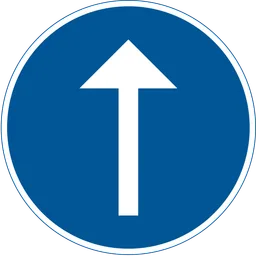
D1-3Mandatory Signs
Direction to be followed, straight ahead only
Swedish name: Påbjuden körriktning - Rakt fram
The road sign indicates that you must drive in the direction of the arrow. In this case, you must continue straight ahead. The road sign is used where there are other possible directions you are not allowed to choose.
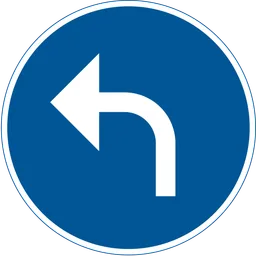
D1-4Mandatory Signs
Direction to be followed, turn left
Swedish name: Påbjuden körriktning - Sväng vänster
The road sign indicates that you must turn in the direction of the arrow. In this case, you must turn left. The road sign is used where there are other possible directions you are not allowed to choose.
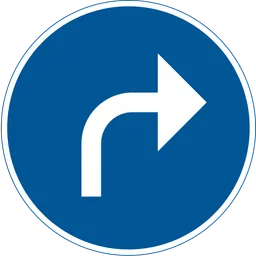
D1-5Mandatory Signs
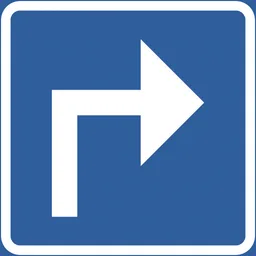
Direction to be followed, turn right
Swedish name: Påbjuden körriktning - Sväng höger
The road sign indicates that you must turn in the direction of the arrow. In this case, you must turn right. The road sign is used where there are other possible directions you are not allowed to choose.
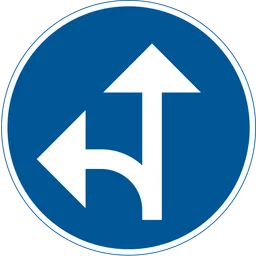
D1-6Mandatory Signs
Direction to be followed, turn left or continue straight ahead
Swedish name: Påbjuden körriktning - Rakt fram eller sväng vänster
The road sign indicates that you must drive in either of the directions of the arrows. In this case, you must turn left or continue straight ahead. The road sign is used where there are other possible directions you are not allowed to choose.
D1-7Mandatory Signs
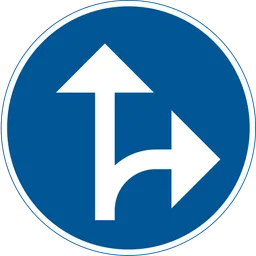
Direction to be followed, turn right or continue straight ahead
Swedish name: Påbjuden körriktning - Rakt fram eller sväng höger
The road sign indicates that you must drive in either of the directions of the arrows. In this case, you must turn right or continue straight ahead. The road sign is used where there are other possible directions you are not allowed to choose.
D1-8Mandatory Signs
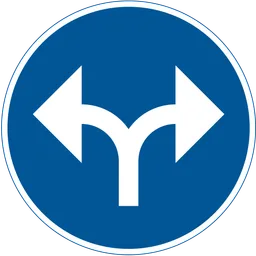
Direction to be followed, turn left or right
Swedish name: Påbjuden körriktning - Sväng vänster eller höger
The road sign indicates that you must turn in either of the directions of the arrows. The road sign is used where there are other possible directions you are not allowed to choose.
D2-1Mandatory Signs
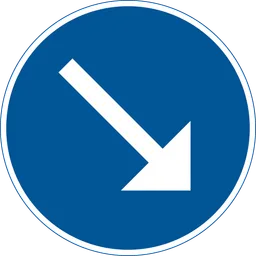
Pass this side, right
Swedish name: Påbjuden körbana - Höger
The road sign indicates that vehicles only may drive past the road sign where the arrow is pointing. In this case you should drive on a carriageway to the right of the road sign. The symbol is adapted to the conditions of the location.
D2-2Mandatory Signs
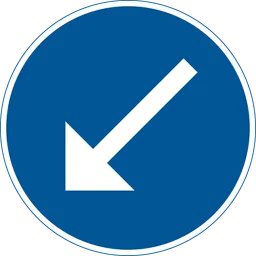
Pass this side, left
Swedish name: Påbjuden körbana - Vänster
The road sign indicates that vehicles only may drive past the road sign where the arrow is pointing. In this case you should drive on a carriageway to the left of the road sign. The symbol is adapted to the conditions of the location.
D2-3Mandatory Signs
Pass this side, either side
Swedish name: Påbjuden körbana - Höger eller vänster
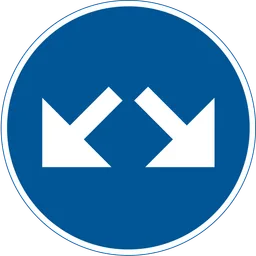
The road sign indicates that vehicles only may drive past the sign where the arrows are pointing. In this case you should drive on a carriageway to the left or right of the road sign. The symbol is adapted to the conditions of the location.
D3-1Mandatory Signs
Roundabout
Swedish name: Cirkulationsplats
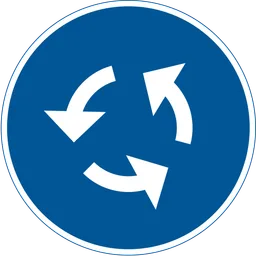
The road sign indicates that you are about to enter a roundabout. The road sign is always posted close to the roundabout, as opposed to the warning sign "Roundabout ahead", which warns of a roundabout further down the road.
D4-1Mandatory Signs
Cycle path
Swedish name: Påbjuden cykelbana
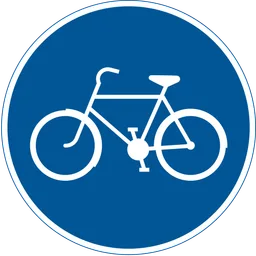
The road sign indicates that the path after the road sign is a cycle path. In Sweden, drivers of class 2 moped are also allowed to use cycle paths (and lanes). If drivers of class 2 moped are not allowed to use the cycle path, this is indicated on an additional panel.
D5-1Mandatory Signs
Footpath
Swedish name: Påbjuden gångbana
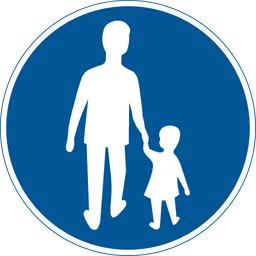
The road sign indicates that the path after the road sign is a footpath for pedestrians only. Other road users, cyclists included, must not travel on it. Pavements (sidewalks) are also considered as footpaths, even if they are not marked with the road sign "Footpath". If you have to cross a pavement in order to get to the carriageway, for example when driving out of a garage, you must of course give way to all road users on the sidewalk. You must also give way to all traffic on the carriageway, as the exit rule applies after crossing a foot or cycle path.
D6-1Mandatory Signs
Footpath and cycle path, shared
Swedish name: Påbjuden gång- och cykelbana - Gemensam
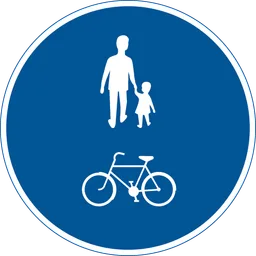
The road sign indicates that the path after the road sign is a shared path for pedestrians and cyclists. Drivers of class 2 moped are also allowed to use the path. If drivers of class 2 moped are not allowed to use the path, this is indicated on an additional panel.
D7-1Mandatory Signs
Footpath and cycle path, divided
Swedish name: Påbjudna gång- och cykelbanor - Uppdelad
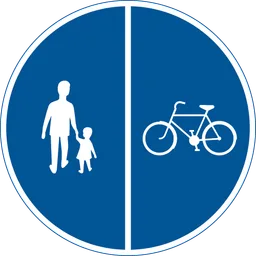
The road sign indicates that the path after the road sign is a divided path for pedestrians and cyclists. The footpath and the cycle path is divided with a solid line. In this case, the footpath is to the left and the cycle path is to the right. Drivers of class 2 moped are also allowed to use the cycle path. If drivers of class 2 moped are not allowed to use the path, this is indicated on an additional panel.
D7-2Mandatory Signs
Cycle path and footpath, divided
Swedish name: Påbjudna cykel- och gångbanor - Uppdelad
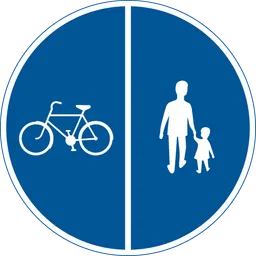
The road sign indicates that the path after the road sign is a divided path for cyclists and pedestrians. The cycle path and the footpath is divided with a solid line. In this case, the cycle path is to the left and the footpath is to the right. Drivers of class 2 moped are also allowed to use the cycle path. If drivers of class 2 moped are not allowed to use the path, this is indicated on an additional panel.
D8-1Mandatory Signs
Track for riders on horseback
Swedish name: Påbjuden ridväg
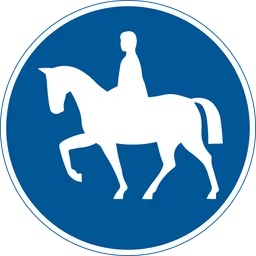
The road sign indicates that the track after the road sign is a track for riders on horseback. Pedestrians may also use the track.
D9-1Mandatory Signs
Track for off-road motor vehicles and off-road trailers
Swedish name: Påbjuden led för terrängmotorfordon och terrängsläp
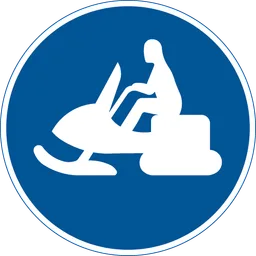
The road sign indicates that the track after the road sign is a track for off-road motor vehicles (for example, snow scooters) and off-road trailers. Pedestrians may also use the track.
D10-1Mandatory Signs
Lane for public transport vehicles
Swedish name: Påbjudet körfält eller körbana för fordon i linjetrafik
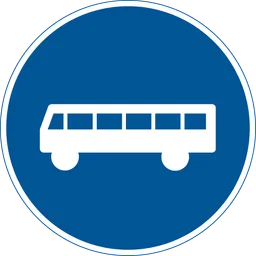
The road sign indicates that the lane or carriageway after the road sign is a lane reserved for public transport vehicles. The lane or carriageway itself is also marked with the text "BUSS". Lanes for public transport may only be used by vehicles in regular service and, if the lane is located to the right in the direction of travel, cycles and class 2 mopeds. Additional panels may prohibit traffic by cycle and moped class 2, or allow traffic for other vehicles.
D11-1Mandatory Signs
End of lane for public transport vehicles
Swedish name: Slut på påbjudet körfält eller körbana för fordon i linjetrafik
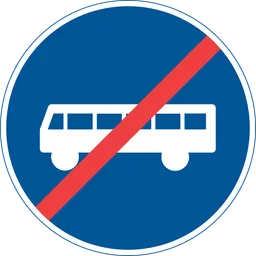
The road sign indicates that the lane or carriageway reserved for public transport vehicles ends. The road sign does not prohibit anything, it only states that the lane or carriageway is no longer reserved for public transport vehicles. Other symbols for other types of vehicles or groups of road users may be inserted in the sign. The symbol inserted in the sign is the same as on the sign used to mark out the carriageway, lane, path or track.
D11-2Mandatory Signs
End of cycle path
Swedish name: Slut på påbjuden cykelbana
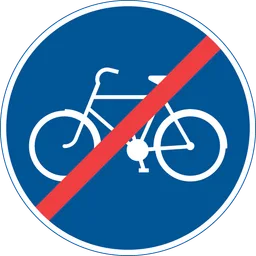
The road sign indicates that the cycle path ends. The road sign does not prohibit anything, it only states that the path is no longer reserved for cyclists. Other symbols for other types of vehicles or groups of road users may be inserted in the sign. The symbol inserted in the sign is the same as on the sign used to mark out the carriageway, lane, path or track.
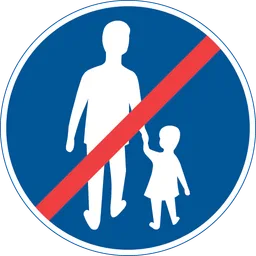
D11-3Mandatory Signs
End of footpath
Swedish name: Slut på påbjuden gångbana
The road sign indicates that the footpath ends. The road sign does not prohibit anything, it only states that the path is no longer reserved for pedestrians. Other symbols for other types of vehicles or groups of road users may be inserted in the sign. The symbol inserted in the sign is the same as on the sign used to mark out the carriageway, lane, path or track.
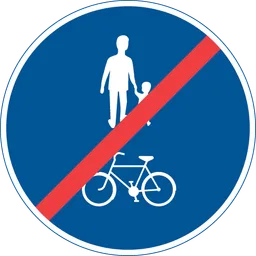
D11-4Mandatory Signs
End of foot and cycle path, shared
Swedish name: Slut på påbjuden gång- och cykelbana
The road sign indicates that the foot and cycle path ends. The road sign does not prohibit anything, it only states that the path is no longer reserved for pedestrians and cyclists. Other symbols for other types of vehicles or groups of road users may be inserted in the sign. The symbol inserted in the sign is the same as on the sign used to mark out the carriageway, lane, path or track.
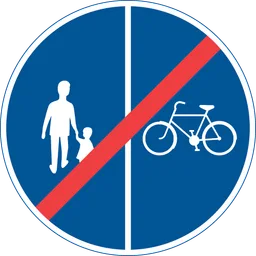
D11-5Mandatory Signs
End of foot and cycle paths, divided
Swedish name: Slut på påbjudna gång- och cykelbanor
The road sign indicates that the foot and cycle paths end. The road sign does not prohibit anything, it only states that the path is no longer reserved for pedestrians and cyclists. Other symbols for other types of vehicles or groups of road users may be inserted in the sign. The symbol inserted in the sign is the same as on the sign used to mark out the carriageway, lane, path or track.
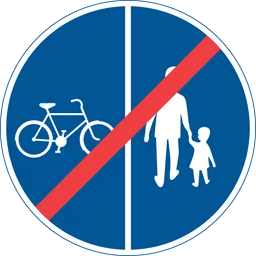
D11-6Mandatory Signs
End of cycle path and footpath, divided
Swedish name: Slut på påbjudna cykel- och gångbanor
The road sign indicates that the cycle path and footpath end. The road sign does not prohibit anything, it only states that the path is no longer reserved for cyclists and pedestrians. Other symbols for other types of vehicles or groups of road users may be inserted in the sign. The symbol inserted in the sign is the same as on the sign used to mark out the carriageway, lane, path or track.
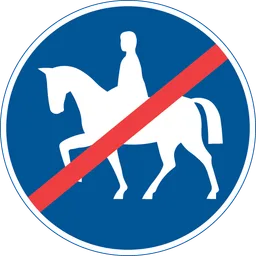
D11-7Mandatory Signs
End of track for riders on horseback
Swedish name: Slut på påbjuden ridväg
The road sign indicates that the track for riders on horseback ends. The road sign does not prohibit anything, it only states that the track is no longer reserved for riders on horseback. Other symbols for other types of vehicles or groups of road users may be inserted in the sign. The symbol inserted in the sign is the same as on the sign used to mark out the carriageway, lane, path or track.
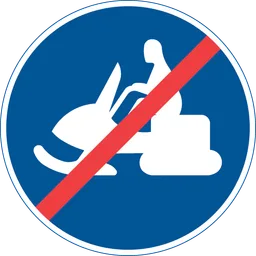
D11-8Mandatory Signs
End of track for off-road motor vehicles and off-road trailers
Swedish name: Slut på påbjuden led för terrängmotorfordon och terrängsläp
The road sign indicates that the track for off-road motor vehicles and off-road trailers ends. The road sign does not prohibit anything, it only states that the track is no longer reserved for track for off-road motor vehicles and off-road trailers. Other symbols for other types of vehicles or groups of road users may be inserted in the sign. The symbol inserted in the sign is the same as on the sign used to mark out the carriageway, lane, path or track.
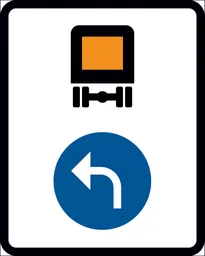
D12-1Mandatory Signs
Direction to be followed for vehicles carrying dangerous goods
Swedish name: Påbjuden körriktning för fordon lastat med farligt gods
The road sign indicates that vehicles carrying dangerous goods must turn in the direction of the arrow. A capital letter on the road sign indicates that the mandatory order only refers to such vehicles that may not be driven in a road tunnel that belongs to the tunnel category that corresponds to the letter.
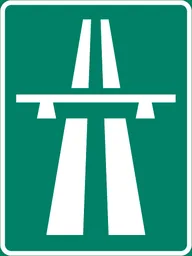
E1-1Advisory Signs
Motorway
Swedish name: Motorväg
The road sign tells you that a motorway begins. The road sign is posted at motorway entry slip roads and in places where another type of road becomes a motorway. If the sign is used preparatory, the distance to the motorway is indicated on an additional panel. The road sign can also be inserted in a direction sign.
E2-1Advisory Signs
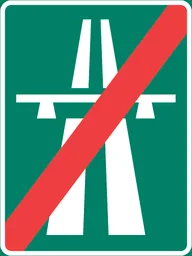
Motorway ends
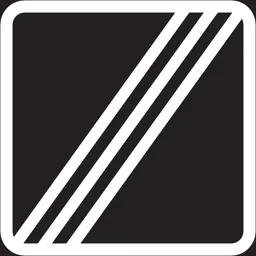
Swedish name: Motorväg upphör
The road sign tells you that a motorway ends. If the sign is used preparatory, the distance to the end of the motorway is indicated on an additional panel.
E3-1Advisory Signs
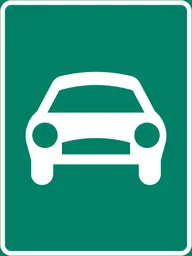
Clearway
Swedish name: Motortrafikled
The road sign tells you that a clearway begins. The road sign is posted at clearway entry roads and in places where another type of road becomes a clearway. If the sign is used preparatory, the distance to the clearway is indicated on an additional panel. The road sign can also be inserted in a direction sign.
E4-1Advisory Signs
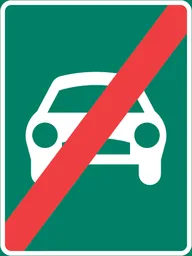
Clearway ends
Swedish name: Motortrafikled upphör
The road sign tells you that a clearway ends. If the sign is used preparatory, the distance to the end of the clearway is indicated on an additional panel.
E5-1Advisory Signs
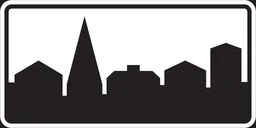
Densely built-up area
Swedish name: Tättbebyggt område
The road sign tells you that a densely built-up area begins. The basic speed limit in densely built-up areas is 50 km/h. On many roads other speed limits apply, but they are then clearly indicated on a road sign or similar device.
E6-1Advisory Signs
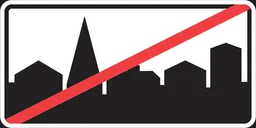
Densely built-up area ends
Swedish name: Tättbebyggt område upphör
The road sign tells you that a densely built-up area ends. Note that the road sign no longer automatically means that 70 km/h applies.
E7-1Advisory Signs
Pedestrian zone
Swedish name: Gågata
The road sign indicates that the road or area after the road sign is a pedestrian zone. A pedestrian zone is a place where all vehicle traffic must be adapted to pedestrians. It is normally* not allowed to drive along streets in pedestrian zones. However, drivers are allowed to cross them if they follow the rules for residential areas. The following rules apply in residential areas: - Vehicles must not be driven faster than walking speed (5 km/h). - Vehicles must not be parked in any place other than marked parking spaces. - Vehicle drivers must give way to pedestrians. - Vehicle drivers have a duty to give way to all traffic when leaving the area.
E8-1Advisory Signs
Pedestrian zone ends
Swedish name: Gågata upphör
The road sign indicates that the road or area after the road sign no longer is a pedestrian zone. The road sign does not need to be posted if it is clear that the pedestrian zone is ending.
E9-1Advisory Signs
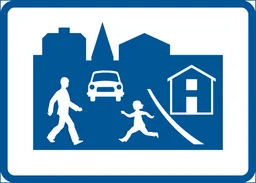
Residential area
Swedish name: Gångfartsområde
The road sign indicates that the area after the road sign is a residential area. A residential area is a place (usually a street or a square) where all vehicle traffic must be adapted to pedestrians. The following rules apply in residential areas: - Vehicles must not be driven faster than walking speed (5 km/h). - Vehicles must not be parked in any place other than marked parking spaces. - Vehicle drivers must give way to pedestrians. - Vehicle drivers have a duty to give way to all traffic when leaving the area.
E10-1Advisory Signs
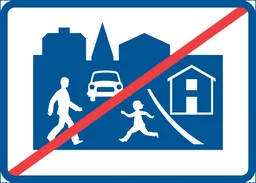
Residential area ends
Swedish name: Gångfartsområde upphör
The road sign indicates that the road or area after the road sign no longer is a residential area. The road sign does not need to be posted if it is clear that the residential area is ending.
E11-4Advisory Signs
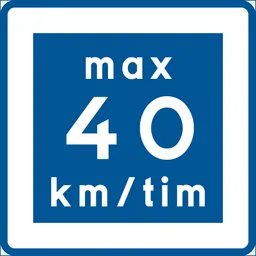
Recommended lower speed, 40 km/h
Swedish name: Rekommenderad lägre hastighet - 40 km/h
The road sign indicates a stretch of road or an area where specific speed reduction measures have been implemented – usually through the use of speed bumps or other obstacles – or where conditions are such that it is appropriate to drive at a lower speed than the maximum permissible. The recommendation is mainly used to protect pedestrians and other unprotected road users. Driving at a higher speed than indicated on the sign is not prohibited, but it is inappropriate. 50 km/h is usually the maximum permissible speed, as the sign is most commonly found in densely built-up areas. The recommended lower speed is stated on the road sign. In this case it is 40 km/h.
E12-4Advisory Signs
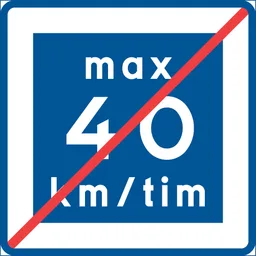
Recommended lower speed ends, 40 km/h
Swedish name: Rekommenderad lägre hastighet upphör - 40 km/h
The road sign indicates that the recommended lower speed and any speed reduction measures ends and that the previous speed limit (usually 50 km/h) now applies instead. The recommended lower speed that ends is stated on the road sign. In this case it was 40 km/h. The road sign does not need to be posted if it is clear that the stretch of road ends.
E13-9Advisory Signs
Recommended maximum speed, 90 km/h
Swedish name: Rekommenderad högsta hastighet - 90 km/h
The adjustable electronic road sign indicates that conditions are temporarily such that it is not appropriate to drive at a higher speed than that stated on the road sign. The stated speed is always lower than the posted speed limit. It is therefore legal – but inappropriate – to drive at a higher speed. However, if the stated speed is surrounded by a red circle, you must not drive at a higher speed. These road signs are only found on major roads are usually only activated when there is heavy traffic or when conditions are temporarily such that it is appropriate to reduce speed. The recommended maximum speed is stated on the road sign. In this case it is 90 km/h.
E14-1Advisory Signs
Recommended maximum speed ends
Swedish name: Rekommenderad högsta hastighet upphör
The road sign indicates that the recommended maximum speed ends and that the previously posted speed limit now applies. The road sign does not need to be posted if it is clear that the stretch of road ends.
E15-1Advisory Signs
Merge
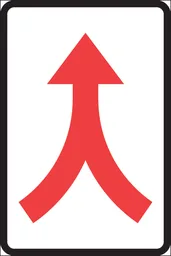
Swedish name: Sammanvävning
The road sign indicates that two lanes or carriageways are merging into one and that drivers must show mutual consideration and adapt to the new conditions at the location. The merge shall be made using the so-called "zipper merge", which means that one vehicle at a time from each lane is allowed to proceed – first one from the right, then one from the left, then one from the right and so on.
E16-1Advisory Signs
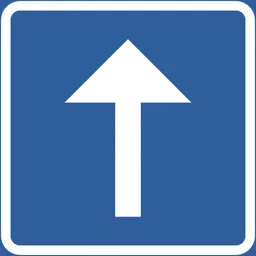
One-way traffic
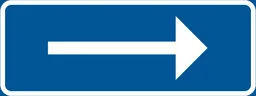
Swedish name: Enkelriktad trafik
The road sign indicates that vehicle traffic on the road is one-way in the direction of the arrow.
E16-2Advisory Signs
One-way traffic, straight ahead
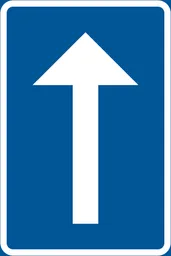
Swedish name: Enkelriktad trafik - Rakt fram
The road sign indicates that vehicle traffic on the road is one-way straight ahead.
E17-1Advisory Signs
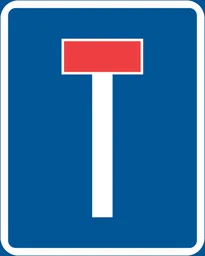
No through road
Swedish name: Återvändsväg
The road sign indicates a no through road (often called "dead-end street") and that passage is not possible. The symbol is adapted to the conditions of the location and can be inserted in a direction sign. If passage is possible with cycle or moped, this is indicated by a cycle symbol inserted in the road sign.
E18-1Advisory Signs
Passing place
Swedish name: Mötesplats
The road sign indicates a wider part of a narrow road where it is suitable for two vehicles to pass each other. Parking at passing places is prohibited.
E19-1Advisory Signs
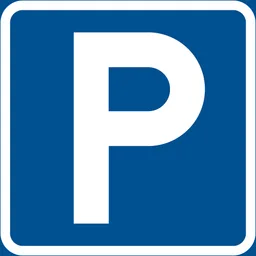
Parking
Swedish name: Parkering
The road sign indicates that parking is allowed at a parking lot or on the side of the road where the sign is placed for a maximum of 24 hours on weekdays. Saturdays, days before holidays, Sundays and holidays have no time limit*. Additional panels often limit the time and inform about any fees. * Example: If you park on a Friday at 18:00 you do not need to move the car until Monday at 24.00 because the weekend resets the 24-hour rule.
E20-1Advisory Signs
Zone sign, no parking
Swedish name: Områdesmärke - Förbud mot att parkera fordon
The road sign indicates that an area, where the prohibitions or permissions on the sign applies, begins. In this case, parking is prohibited in the area. The road sign is posted at the entrances to the area (for example, a residential or industrial area) and applies until the cancelling sign "End of zone", or until it is clear that the instructions on the sign no longer apply. Deviations from the instructions on the zone sign can be indicated by additional panels and other road signs. Time limits can also be inserted in the sign. The instructions on the zone sign still applies after such deviations, even if the zone sign has not been repeated.
E21-1Advisory Signs
End of zone, no parking
Swedish name: Slut på område - Förbud mot att parkera fordon
The road sign indicates that an area with prohibitions or permissions, indicated by a "Zone sign", ends. In this case, an area with parking prohibition ends. Other prohibitions or permissions can be indicated on the road sign.
E22-1Advisory Signs
Bus stop
Swedish name: Busshållplats
The road sign indicates a stopping-place for public transport vehicles and school transport vehicles. Departure times can be stated on the road sign The road sign does not need to be posted if the stopping-place is otherwise clearly marked.
E23-1Advisory Signs
Taxi
The road sign indicates, in the direction of travel, the far limit of a particular taxi stand.
E24-1Advisory Signs
Automatic traffic surveillance
Swedish name: Automatisk trafikövervakning
The road sign indicates that a road or road section has automatic traffic surveillance for monitoring speed, traffic rules and taxation.
E25-1Advisory Signs
Toll road
Swedish name: Betalväg
The road sign indicates that you must pay a fee or special congestion tax to travel on the road or within the area. In Sweden there is a system of congestion taxes in Stockholm and Gothenburg. The tax applies to vehicles registered in Sweden and outside Sweden. The payment system is completely automatic. When you drive past a tolling station, this is registered and a payment slip is sent to the owner of the vehicle.
E26-1Advisory Signs
Tunnel
This road sign indicates that the road passes through a tunnel. When the sign shows a distance, it tells you how far it is to the end of the tunnel. In longer tunnels, the sign may be repeated after each kilometre. The distance shown then decreases as you drive through the tunnel, so you can see how much of the tunnel remains. The tunnel's name and total length may also be shown on the sign.
E27-1Advisory Signs
Emergency parking area
Swedish name: Nöduppställningsplats
The road sign indicates an emergency parking area for vehicles in case of engine failure or similar. The road sign is most common in tunnels and on certain motorways. The symbols for emergency telephone and fire extinguisher may be inserted in the sign. If the sign is used preparatory, the distance to the emergency parking area is indicated on an additional panel.
E28-1Advisory Signs
Emergency exit, head left
Swedish name: Nödutgång - Åt väster
The road sign indicates emergency exit for pedestrians. The road sign is usually found in tunnels.
E28-2Advisory Signs
Emergency exit, head right
Swedish name: Nödutgång - Åt höger
The road sign indicates emergency exit for pedestrians. The road sign is usually found in tunnels.
E29-1Advisory Signs
Emergency route
Swedish name: Utrymningsväg
The road sign indicates the direction and distance to the emergency exit or equivalent for pedestrians. The road sign, which is most common in tunnels, is set at a maximum of 25 meters apart.
E31-1Advisory Signs
Environmental zone
Swedish name: Miljözon
The road sign tells you that an environmental zone begins. In environmental zones, certain vehicles are not allowed to drive. There are three different classes of environmental zones with different requirements on vehicle type and emissions. Class 3 environmental zone sets the highest requirements. The class of the environmental zone is indicated on the road sign. If the sign is used preparatory, the distance to the environmental zone is indicated on an additional panel. The road sign can also be inserted in a direction sign. The road sign is posted at the entrances to the environmental zone and applies until the road sign "Densely built-up area ends", "Environmental zone ends" or another environmental zone sign is posted.
E32-1Advisory Signs
Environmental zone ends
Swedish name: Slut på miljözon
The road sign tells you that a environmental zone ends.
E33-1Advisory Signs
Cycle street
Swedish name: Cykelgata
The road sign indicates that the area after the road sign is a cycle street. A cycle street is an area of a road or street where all vehicle traffic must be adapted to cyclists. On cycle streets, the following applies: - Vehicles must not be driven faster than 30 km/h. - A driver of a motor vehicle must adapt the speed to the cycle traffic. - Vehicles must not be parked in any place other than marked parking spaces. - Vehicle drivers have a duty to give way to all traffic when leaving the cycle street. - A driver entering a road that is a cycle street has a duty to give way to vehicles on the cycle street. This means that at junctions, where the priority to the right rule applies, those cycling on the cycle street have priority, regardless of whether a vehicle is approaching from the left or the right.
E34-1Advisory Signs
Cycle street ends
Swedish name: Cykelgata upphör
The road sign tells you that a cycle street ends. Vehicle drivers have a duty to give way to all traffic when leaving a cycle street.
F1-1Direction Signs
Direction sign, diagrammatic type
Swedish name: Orienteringstavla
This road sign is called "Direction sign" (diagrammatic type). It gives you preparatory information about a junction (as in the picture), roundabout or equivalent. The road sign's task is to make it easier for you to plan your driving by showing where different roads lead. The road sign is usually posted about 500 meters before the junction, roundabout or equivalent.
F1-2Direction Signs
Direction sign, diagrammatic type
Swedish name: Orienteringstavla
This road sign is called "Direction sign" (diagrammatic type). It gives you preparatory information about a junction, roundabout (as in the picture) or equivalent. The road sign's task is to make it easier for you to plan your driving by showing where different roads lead. The road sign is usually posted about 500 meters before the junction, roundabout or equivalent.
F2-1Direction Signs
Advance direction sign indicating prohibition of left turning
Swedish name: Orienteringstavla vid förbjuden sväng i korsning
The road sign gives you preparatory information about a junction in which it is prohibited to turn left. The road sign, which is usually posted about 500 meters before the junction, also tells you that instead of turning left you can turn right onto an exit slip road and then drive straight across the main road when it is free of traffic. This type of turn is sometimes called a "Spanish turn".
F3-1Direction Signs
Advance direction sign, stack type
Swedish name: Tabellorienteringstavla
This road sign is called "Direction sign" (stack type). It is posted before many junctions and shows the direction to, and road number of, various destinations. The distance to the junction is stated at the bottom of the sign.
F4-1Direction Signs
Advance direction sign exit ahead
Swedish name: Avfartsorienteringstavla
The road sign gives you preparatory information about an exit on a country road or other type of road that is not a motorway or clearway. The distance stated on the sign is adapted to the conditions of the location.
F5-1Direction Signs
Directional sign
Swedish name: Vägvisare
The road sign is posted at junctions and shows the direction to a destination. The blue colour indicates that the road to which it refers is a national road or county road. The distance is stated in kilometres.
F6-1Direction Signs
Direction sign, stack type
Swedish name: Tabellvägvisare
The road sign is called a Direction sign (stack type) and is used just before a junction, a roundabout, or when exiting a roundabout. It shows which destinations you can reach in the different directions and makes it easier to choose the correct lane in time. The sign may include a list of destinations (including road numbers), distances in kilometers, and arrows showing which direction you should drive. The background color of the sign varies depending on the type of road. For example, yellow indicates a private road, blue a public road, and green a motorway or clearway.
F7-1Direction Signs
Direction exit sign
Swedish name: Avfartsvisare
The road sign tells you that an exit road begins and to which destination it leads. If you turn off at this exit you will reach Mora (via national road 70) and Enköping.
F8-1Direction Signs
Lane assignment sign
Swedish name: Körfältsvägvisare
The road sign shows how the lanes are arranged and specifies the lane or lanes that are suitable for use to get to your destination. The road sign shows the options available and provides an indication of which lane you should choose depending on where you are going. The road sign is usually placed above the road. The road sign can also be used preparatory to indicate an exit road. In such cases, the distance to the exit road is indicated on the sign.
F8-2Direction Signs
Lane assignment sign
Swedish name: Körfältsvägvisare
The road sign shows how the lanes are arranged and specifies the lane or lanes that are suitable for use to get to your destination. The road sign shows the options available and provides an indication of which lane you should choose depending on where you are going. In this case, you will reach the international E-road E18 and Stockholm via both the left and right lanes. The road sign is usually placed above the road. The road sign can also be used preparatory to indicate an exit road. In such cases, the distance to the exit road is indicated on the sign. In this case, there is an exit road for Enköping in 500 metres.
F9-1Direction Signs
Collective direction sign
Swedish name: Samlingsmärke för vägvisning
The road sign shows which place name on road signs to follow, to reach other destinations. The destinations that can be reached through a common choice of route is stated within brackets. In this case it is Pajala and Övertorneå. The common choice of route is stated below the brackets. In this case it is Kiruna. In other words, if you are going to either Pajala or Övertorneå you should follow the road signs to Kiruna.
F10-1Direction Signs
Place indication sign
Swedish name: Platsmärke
The road sign indicates a place or other location of importance for orientation. Municipal, city or county weapon may be inserted in the sign.
F11-1Direction Signs
Road name
Swedish name: Vägnamn
The road sign indicates the name of a particular road or route.
F12-1Direction Signs
Watercourse
Swedish name: Vattendrag
The road sign indicates the name of a particular watercourse.
F13-1Direction Signs
Distance sign
Swedish name: Avståndstavla
The road sign shows the distances to different destinations. The distances are stated in kilometres. Road numbers may be inserted in the sign.
F14-1Direction Signs
Road number, international E-road
Swedish name: Vägnummer - Europaväg
The road sign indicates the road number and that it is an international E-road (because it is green). The international E-road network is a number of roads which connect the countries of Europe. International E-road are numbered with an E followed by a 1-3 digits, for example E4, E6 and E22.
F14-2Direction Signs
Direction to a numbered road, international E-road
Swedish name: Vägnummer - Europaväg
A road sign with a dashed border indicates that the road leads to the road that is marked with the number indicated on the sign. In this case the road leads to international E-road E4. The international E-road network is a number of roads which connect the countries of Europe. International E-road are numbered with an E followed by a 1-3 digits, for example E4, E6 and E22.
F14-3Direction Signs
Road number, national road or county road
Swedish name: Vägnummer - Riksväg eller länsväg
The road sign indicates the number of the road and that it is a national road or county road (because it is blue). National roads are numbered from 1 (in the south) to 99 (in the north). National roads usually maintain a relatively high standard.
F14-4Direction Signs
Direction to a numbered road, national road or county road
Swedish name: Vägnummer - Riksväg eller länsväg
A road sign with a dashed border indicates that the road leads to the road that is marked with the number indicated on the sign. In this case the road leads to road 58. National roads are numbered from 1 (in the south) to 99 (in the north). National roads usually maintain a relatively high standard.
F15-1Direction Signs
Road number, diversion
Swedish name: Vägnummermärke vid omledning
The road sign indicates that the road is a permanent diversion route (because it is white) for the regular numbered road and that the regular road is closed. These roads usually have a lower standard than the regular roads.
F16-1Direction Signs
Number of lanes increase
Swedish name: Ökning av antal körfält
The road sign indicates that the number of lanes is increasing. The sign is adapted to the conditions of the location. Symbols for vehicle type, road number or physical boundary (for example, a central barrier) between opposite lanes may be inserted in the sign If the sign is used preparatory, the distance to when the number of lanes is increasing is indicated on an additional panel.
F16-2Direction Signs
Number of lanes increase
Swedish name: Ökning av antal körfält
The road sign indicates that the number of lanes is increasing. The sign is adapted to the conditions of the location. In this case, the sign also shows that there is a lane with oncoming traffic. Symbols for vehicle type, road number or physical boundary (for example, a central barrier) between opposite lanes may be inserted in the sign If the sign is used preparatory, the distance to when the number of lanes is increasing is indicated on an additional panel.
F16-3Direction Signs
Number of lanes increase
Swedish name: Ökning av antal körfält
The road sign indicates that the number of lanes is increasing. The sign is adapted to the conditions of the location. In this case, the sign also shows that there is a separate lane – delimited by a central barrier – with oncoming traffic. Symbols for vehicle type, road number or physical boundary (for example, a central barrier) between opposite lanes may be inserted in the sign If the sign is used preparatory, the distance to when the number of lanes is increasing is indicated on an additional panel.
F16-4Direction Signs
Number of lanes increase
Swedish name: Ökning av antal körfält
The road sign indicates that the number of lanes is increasing. The sign is adapted to the conditions of the location. Symbols for vehicle type, road number or physical boundary (for example, a central barrier) between opposite lanes may be inserted in the sign If the sign is used preparatory, the distance to when the number of lanes is increasing is indicated on an additional panel.
F17-1Direction Signs
Number of lanes decrease
Swedish name: Minskning av antal körfält
The road sign indicates that the number of lanes is decreasing. The sign is adapted to the conditions of the location. Symbols for vehicle type, road number or physical boundary (for example, a central barrier) between opposite lanes may be inserted in the sign If the sign is used preparatory, the distance to when the number of lanes is decreasing is indicated on an additional panel.
F17-2Direction Signs
Number of lanes decrease
Swedish name: Minskning av antal körfält
The road sign indicates that the number of lanes is decreasing. The sign is adapted to the conditions of the location. In this case, the sign also shows that there is a lane with oncoming traffic. Symbols for vehicle type, road number or physical boundary (for example, a central barrier) between opposite lanes may be inserted in the sign If the sign is used preparatory, the distance to when the number of lanes is decreasing is indicated on an additional panel.
F17-3Direction Signs
Number of lanes decrease
Swedish name: Minskning av antal körfält
The road sign indicates that the number of lanes is decreasing. The sign is adapted to the conditions of the location. Symbols for vehicle type, road number or physical boundary (for example, a central barrier) between opposite lanes may be inserted in the sign If the sign is used preparatory, the distance to when the number of lanes is decreasing is indicated on an additional panel.
F18-1Direction Signs
Lane division on road section
Swedish name: Körfältsindelning på sträcka
The road sign indicates the direction of travel of the lanes. The sign is adapted to the conditions of the location. In this case, the sign shows that the carriageway has two lanes in your direction of travel and one lane in the opposite direction. Symbols for vehicle type, road number or physical boundary (for example, a central barrier) between opposite lanes may be inserted in the sign. If the sign is used preparatory, the distance to when the lane division starts is indicated on an additional panel.
F18-2Direction Signs
Lane division on road section
Swedish name: Körfältsindelning på sträcka
The road sign indicates the direction of travel of the lanes. The sign is adapted to the conditions of the location. In this case, the sign shows that the carriageway has one lane in your direction of travel and one separate lane – delimited by a central barrier – in the opposite direction. Symbols for vehicle type, road number or physical boundary (for example, a central barrier) between opposite lanes may be inserted in the sign. If the sign is used preparatory, the distance to when the lane division starts is indicated on an additional panel.
F18-3Direction Signs
Lane division on road section
Swedish name: Körfältsindelning på sträcka
The road sign indicates the direction of travel of the lanes. The sign is adapted to the conditions of the location. In this case, the sign shows that the carriageway has two lanes in your direction of travel. Symbols for vehicle type, road number or physical boundary (for example, a central barrier) between opposite lanes may be inserted in the sign. If the sign is used preparatory, the distance to when the lane division starts is indicated on an additional panel.
F18-4Direction Signs
Lane division on road section
Swedish name: Körfältsindelning på sträcka
The road sign indicates the direction of travel of the lanes. The sign is adapted to the conditions of the location. In this case, the sign shows that the carriageway has one lane in your direction of travel and two lanes in the opposite direction. Symbols for vehicle type, road number or physical boundary (for example, a central barrier) between opposite lanes may be inserted in the sign. If the sign is used preparatory, the distance to when the lane division starts is indicated on an additional panel.
F18-5Direction Signs
Lane division on road section
Swedish name: Körfältsindelning på sträcka
The road sign indicates the direction of travel of the lanes. The sign is adapted to the conditions of the location. In this case, the sign shows that the carriageway has two lanes in your direction of travel and one separate lane – delimited by a central barrier – in the opposite direction. Symbols for vehicle type, road number or physical boundary (for example, a central barrier) between opposite lanes may be inserted in the sign. If the sign is used preparatory, the distance to when the lane division starts is indicated on an additional panel.
F18-6Direction Signs
Lane division on road section
Swedish name: Körfältsindelning på sträcka
The road sign indicates the direction of travel of the lanes. The sign is adapted to the conditions of the location. In this case, the sign shows that the carriageway has one lane in your direction of travel and two separate lanes – delimited by a central barrier – in the opposite direction. Symbols for vehicle type, road number or physical boundary (for example, a central barrier) between opposite lanes may be inserted in the sign. If the sign is used preparatory, the distance to when the lane division starts is indicated on an additional panel.
F19-1Direction Signs
Connecting road with acceleration lane
Swedish name: Väganslutning med accelerationsfält
The road sign indicates that an acceleration lane will connect to the road. The sign is adapted to the conditions of the location. In this case, the sign shows that the carriageway has two lanes in your direction of travel and that an acceleration lane will connect to the road from the right. In case of a temporary traffic diversion, the sign may have an orange background.
F20-1Direction Signs
Connecting road in a separate lane
Swedish name: Väganslutning med separat körfält
The road sign indicates that a separate lane will connect to the road. The sign is adapted to the conditions of the location. In this case, the sign shows that the carriageway has two lanes in your direction of travel and that a separate lane will connect to the road from the right. In case of a temporary traffic diversion, the sign may have an orange background.
F21-1Direction Signs
Lane division before junction
Swedish name: Körfältsindelning före korsning
The road sign shows the appropriate lane for continued travel. The sign is adapted to the conditions of the location. In this case, the sign shows that the left lane is suitable for traveling straight ahead and to the left, while the right lane is suitable for traveling to the right. The sign acts as a kind of map that shows how the lanes are divided – and in which direction they continue – before junctions, to help you choose the correct lane. The arrows on the sign correspond to the white lane arrows painted on the road just before the junction.
F22-1Direction Signs
Country border
Swedish name: Riksmärke
The road sign indicates a border with another EU country.
F23-1Direction Signs
Diversion route
Swedish name: Orienteringstavla för omledningsväg
The road sign indicates the diversion route when the ordinary road is temporarily closed.
F24-1Direction Signs
Direction of travel during temporary diversion
Swedish name: Färdriktning vid omledning
The road sign indicates which direction of travel applies when the traffic is temporarily diverted. The road sign is commonly used at roadworks in densely built-up areas.
F25-1Direction Signs
Lane ends
Swedish name: Körfält upphör
The road sign indicates that a lane has been temporarily closed because of road work, and that you have to change to another lane. The sign is adapted to the conditions of the location.
F26-1Direction Signs
Lane closed
Swedish name: Körfält avstängt
The road sign indicates that a lane has been temporarily closed due to an obstacle in the lane. The sign is adapted to the conditions of the location.
F26-2Direction Signs
Lane closed
Swedish name: Körfält avstängt
The road sign indicates that a lane has been temporarily closed due to an obstacle in the lane. In this case, the sign shows that the obstacle is in the opposite lane, which means that oncoming traffic can occur in your lane. The sign is adapted to the conditions of the location.
F27-1Direction Signs
Exit number
Swedish name: Trafikplatsnummer
The road sign indicates the exit number. On many major roads, the preparatory exit signs and exit signs are provided with an exit number. On the roads where they are used, each exit is provided with a special number and the exit numbers follow in sequence along the road. Exit numbers make it easier to give and follow directions.
F28-1Direction Signs
Car park
Swedish name: Parkeringshus
The road sign indicates a car park. Information regarding occupancy may be inserted in the sign. The road sign may also be inserted in a direction signs for road guidance.
F29-1Direction Signs
Park and ride, subway
Swedish name: Infartsparkering - Tunnelbana
The road sign indicates a parking lot adjacent to a subway station. The road sign may be inserted in a direction signs for road guidance.
F29-2Direction Signs
Park and ride, bus
Swedish name: Infartsparkering - Buss
The road sign indicates a parking lot adjacent to a bus stop. The road sign may be inserted in a direction signs for road guidance.
F29-3Direction Signs
Park and ride, train
Swedish name: Infartsparkering - Tåg
The road sign indicates a parking lot adjacent to a train station. The road sign may be inserted in a direction signs for road guidance.
F30-1Direction Signs
Ring road
Swedish name: Lokal slinga
The road sign indicates a ring road. A ring road (also known as a "local loop", "beltline" or "orbital") is a road or a series of connected roads encircling a city to divert traffic from the city centre.
F31-5Direction Signs
Suitable road or bypass for a particular vehicle type or road user group
Swedish name: Lämplig väg eller förbifart för visst fordonsslag eller trafikantgrupp - Personbil
The road sign is an additional panel that indicates that the road or bypass is suitable for a particular vehicle type or road user group. In this case the road or bypass is suitable for private cars, but other symbols for other vehicles or groups of road users may be inserted in the sign.
F32-1Direction Signs
Dangerous goods
Swedish name: Farligt gods
The road sign indicates the recommended route for vehicles carrying dangerous goods. Vehicles carrying dangerous goods are sometimes diverted around densely built-up areas to reduce the risk of accidents and minimize the consequences of an accident.
F33-1Direction Signs
Rescue location
Swedish name: Räddningsplats
The road sign indicates a rescue location at roadworks or similar.
F34-1Pedestrian & Cycle Signs
Directional sign for pedestrians and cyclists
Swedish name: Vägvisare för gång- och cykeltrafik
The road sign indicates the way to a place, point of interest, facility or similar. The distance in kilometres can be specified. The sign is placed at junctions on foot and cycle paths.
F35-1Pedestrian & Cycle Signs
Direction sign for pedestrians and cyclists, stack type
Swedish name: Tabellvägvisare för gång- och cykeltrafik
The road sign indicates the way to a place, point of interest, facility or similar. The distance in kilometres can be specified. The sign is placed at junctions on foot and cycle paths.
F36-1Pedestrian & Cycle Signs
Place name for pedestrians and cyclists
Swedish name: Platsmärke för gång- och cykeltrafik
The road sign indicates a place or other place of importance for the orientation.
F37-1Pedestrian & Cycle Signs
Distance sign for pedestrians and cyclists
Swedish name: Avståndstavla för gång- och cykeltrafik
The road sign indicates the distance to a place, point of interest, facility or similar. The distance is specified in kilometres.
F38-1Pedestrian & Cycle Signs
Cycle trail
Swedish name: Cykelled
The road sign indicates a specially arranged cycle trail. The colour of the road sign may vary.
G1-1Public Institution Signs
Postal office
Swedish name: Post
The road sign indicates a postal office where letter and parcel handling and stamp sales are offered.
G2-1Public Institution Signs
Emergency telephone
Swedish name: Hjälptelefon
The road sign indicates an emergency telephone. Emergency telephones are directly connected to the nearest alarm centre and are common at the roadside on motorways.
G3-1Public Institution Signs
Radio station for road traffic information
Swedish name: Radiostation för vägtrafikinformation
The road sign indicates that road traffic information is given in regular transmissions intended to cover a larger area.
G4-1Public Institution Signs
Emergency hospital
Swedish name: Akutsjukhus
The road sign indicates a hospital with emergency room.
G5-1Public Institution Signs
Industrial zone
Swedish name: Industriområde
The road sign indicates an industrial zone or area with similar operations.
G6-1Public Institution Signs
Railway station
Swedish name: Järnvägsstation
The road sign indicates a railway station.
G7-1Public Institution Signs
Bus station
Swedish name: Busstation
The road sign indicates a bus station which is the hub for several bus lines.
G8-1Public Institution Signs
Airport
Swedish name: Flygplats
The road sign indicates an airport with regular air traffic.
G9-1Public Institution Signs
Fire extinguisher
Swedish name: Brandsläckare
The road sign indicates a fire extinguisher. The sign is usually used in tunnels.
G10-1Public Institution Signs
Commercial area
Swedish name: Handelsområde
The road sign indicates a commercial area.
G11-1Public Institution Signs
Ferry
Swedish name: Färja
The road sign indicates a ferry location or that the specified destination is reached by ferry.
G12-1Public Institution Signs
Foot ferry
Swedish name: Personfärja
The road sign indicates a ferry location for foot ferry or that the specified destination is reached by foot ferry.
H1-1Service Facility Signs
Information point
Swedish name: Informationsplats
The road sign indicates an information point.
H2-1Service Facility Signs
Vehicle workshop
Swedish name: Fordonsverkstad
The road sign indicates a vehicle workshop.
H4-1Service Facility Signs
Vehicle gas
Swedish name: Gas för fordonsdrift
The road sign indicates facilities that provide different types of vehicle gas. The type of gas is indicated by the abbreviation on the sign. CNG means Compressed Natural Gas. LPG means Liquid Petroleum Gas.
H5-1Service Facility Signs
Light refreshments
Swedish name: Servering
The road sign indicates a facility that serves drinks and simple dishes.
H6-1Service Facility Signs
Restaurant
Swedish name: Restaurang
The road sign indicates a restaurant that serves cooked food.
H7-1Service Facility Signs
Hotel
Swedish name: Hotell
The road sign indicates a hotel or other form of accommodation.
H8-1Service Facility Signs
Hostel
Swedish name: Vandrarhem
The road sign indicates a hostel. Hostels generally have a much simpler standard than hotels.
H9-1Service Facility Signs
Cabin village
Swedish name: Stugby
The road sign indicates a facility with a large number of cabins.
H10-1Service Facility Signs
Cabin
Swedish name: Stuga
The road sign indicates a facility with a few cabins.
H11-1Service Facility Signs
Camping site
Swedish name: Campingplats
The road sign indicates a facility that provides places for tents as well as caravans and camper vans.
H12-1Service Facility Signs
Caravan site
Swedish name: Husvagnsplats
The road sign indicates a facility that provides places for caravans and camper vans.
H13-1Service Facility Signs
Service area
Swedish name: Rastplats
The road sign indicates a service area with an accessible public toilet.
H14-1Service Facility Signs
Toilet
Swedish name: Toalett
The road sign indicates an accessible public toilet.
H15-1Service Facility Signs
Bathing area
Swedish name: Badplats
The road sign indicates a bathing area. The sign may refer to a bathing area by the sea or a lake, or to a swimming pool.
H16-1Service Facility Signs
Recreational area
Swedish name: Friluftsområde
The road sign indicates a recreational area There are often campsites or opportunities to camp in the area.
H17-1Service Facility Signs
Hiking trail
Swedish name: Vandringsled
The road sign indicates a hiking trail.
H18-1Service Facility Signs
Chair lift
Swedish name: Stollift
The road sign indicates a ski resort with chair lifts or similar.
H19-1Service Facility Signs
Ski tow
Swedish name: Släplift
The road sign indicates a ski resort with ski tows or similar.
H20-1Service Facility Signs
Golf course
Swedish name: Golfbana
The road sign indicates a golf course.
H21-1Service Facility Signs
Fishing license sales location
Swedish name: Försäljningsställe för fiskekort
The road sign indicates a sales location for fishing licenses.
H22-1Service Facility Signs
Tourist attraction
Swedish name: Sevärdhet
The road sign indicates a tourist attraction of national interest.
H23-1Service Facility Signs
Advance information on roadside services
Swedish name: Förberedande upplysning om vägnära service
The road sign indicates roadside service facilities and in some cases their names. The distance to the exit or junction is also stated on the sign.
H24-1Service Facility Signs
Bed and breakfast
Swedish name: Rum och frukost
The road sign indicates a facility providing rooms for overnight stay and breakfast.
H3-1Service Facility Signs
Fuel
Swedish name: Drivmedel
The road sign indicates a petrol station. Along motorways, this symbol is very common on direction signs to show which exits lead to petrol stations.
H25-1Service Facility Signs
Farm shop
Swedish name: Gårdsbutik
The road sign indicates a farm shop.
H26-1Service Facility Signs
Handicrafts
Swedish name: Hantverk
The road sign indicates a facility where handicraft products are manufactured and sold.
H27-1Service Facility Signs
Charging station
Swedish name: Laddstation
The road sign indicates a place for external charging of electric vehicles and plug-in hybrids.
H28-1Service Facility Signs
Motor home site
Swedish name: Husbilsplats
The road sign indicates a facility that only provides places for motor homes (cars with accommodation space).
I1-1Tourist Attraction Signs
Tourist route
Swedish name: Turistväg
The road sign indicates a road or stretch of road of great tourist interest. The road sign may be inserted in a direction sign for road guidance.
I2-1Tourist Attraction Signs
Tourist area
Swedish name: Turistområde
The road sign indicates a tourist area. The symbol on the sign is adapted to the theme of the tourist area.
I3-1Tourist Attraction Signs
Landmark
Swedish name: Landmärke
The road sign indicates a landmark of great tourist interest that can be seen from the road. The symbol on the sign shows a silhouette of the place.
I4-1Tourist Attraction Signs
World heritage
Swedish name: Världsarv
The road sign indicates a UNESCO World Heritage Site. The road sign may be inserted in a direction sign for road guidance.
J2-1Information Signs
Information sign
Swedish name: Upplysningsmärke
The road sign provides significant information regarding accessibility or safety that cannot be provided with any other road signs. Warning or prohibition signs may be inserted to provide preparatory information.
J3-2Information Signs
Danger, high voltage
Swedish name: Livsfarlig ledning
The road sign indicates that there is an electrical conduit over the road or trail that could pose a danger.
S1-1Symbols
Heavy truck
Swedish name: Tung lastbil
The symbol is used on direction signs or additional panels to show that the information applies to heavy trucks. The symbol can be depicted on different types of signs against different background colours.
S2-1Symbols
Heavy truck with trailer
Swedish name: Tung lastbil med tillkopplad släpvagn
The symbol is used on direction signs or additional panels to show that the information applies to heavy trucks with trailers. The symbol can be depicted on different types of signs against different background colours.
S3-1Symbols
Private car
Swedish name: Personbil
The symbol is used on direction signs or additional panels to show that the information applies to private cars. The symbol can be depicted on different types of signs against different background colours.
S4-1Symbols
Private car with trailer
Swedish name: Personbil med tillkopplad släpkärra
The symbol is used on direction signs or additional panels to show that the information applies to private cars with trailers. The symbol can be depicted on different types of signs against different background colours.
S5-1Symbols
Bus
Swedish name: Buss
The symbol is used on direction signs or additional panels to show that the information applies to buses. The symbol can be depicted on different types of signs against different background colours.
S6-1Symbols
Tractor and motorised equipment class 2
Swedish name: Traktor och motorredskap klass 2
The symbol is used on direction signs or additional panels to show that the information applies to tractor and motorised equipment class 2. The symbol can be depicted on different types of signs against different background colours.
S7-1Symbols
Motorcycle and moped class 1
Swedish name: Motorcykel och moped klass 1
The symbol is used on direction signs or additional panels to show that the information applies to two-wheeled motorcycles and mopeds class 1 (without sidecars). The symbol can be depicted on different types of signs against different background colours.
S8-1Symbols
Cycle and moped class 2
Swedish name: Cykel och moped klass 2
The symbol is used on direction signs or additional panels to show that the information applies to cycles and mopeds class 2. The symbol can be depicted on different types of signs against different background colours.
S9-1Symbols
Trailer
Swedish name: Släpkärra
The symbol is used on direction signs or additional panels to show that the information applies to trailers. The symbol can be depicted on different types of signs against different background colours.
S10-1Symbols
Pedestrians
Swedish name: Gående
The symbol is used on direction signs or additional panels to show that the information applies to pedestrians. The symbol can be depicted on different types of signs against different background colours.
S11-1Symbols
People with disabilities
Swedish name: Rörelsehindrade
The symbol is used on direction signs or additional panels to show that the information applies to people with disabilities. The symbol can be depicted on different types of signs against different background colours.
S12-1Symbols
Private car class 2
Swedish name: Personbil klass 2
The symbol is used on direction signs or additional panels to show that the information applies to private car class 2 (motor homes or trucks). The symbol can be depicted on different types of signs against different background colours.
S13-1Symbols
Foot ferry
Swedish name: Personfärja
The road sign indicates a ferry location for foot ferry or that the specified destination is reached by foot ferry. The symbol can be depicted on different types of signs against different background colours.
T1-1Additional Panels
Length of road section
Swedish name: Vägsträckas längd
The additional panel always supplement another road sign and indicates the beginning and end of a stretch of road. In this case, the stretch of road begins in 200 metres and ends in 800 meters, which means that the stretch of road is 600 metres long (800 - 200 = 600). The information can be shown on different types of signs against different background colours.
T2-1Additional Panels
Distance
Swedish name: Avstånd
The additional panel always supplement another road sign and states the distance to the hazard, prohibition, mandatory order or the like to which the road sign refers. The information can be shown on different types of signs against different background colours.
T3-1Additional Panels
Distance to mandatory stop
Swedish name: Avstånd till stopplikt
The additional panel is only used below the road sign "Duty to give way" and indicates the distance to mandatory stop.
T4-1Additional Panels
Clear width
Swedish name: Fri bredd
The additional panel indicates the width of the road in case of a temporary obstacle. If the road is less than 5 meters wide, heavy trucks and other large vehicle cannot proceed at the same time. If the road is less than 4 metres wide, it will be difficult for private cars to proceed at the same time. Note that it if an obstacle on or next to the road makes it difficult, dangerous or impossible to proceed at the same time as another vehicle, and nothing else regulates the duty to give way, it is the driver with the obstacle on his or her side of the road that should stop and give way.
T5-1Additional Panels
Total weight
Swedish name: Totalvikt
The additional panel always supplement a prohibitory sign and indicates that the prohibition only applies to vehicles with a certain minimum total weight. In this case the prohibition only applies to vehicles with a total weight of at least 3,500 kg.
T6-1Additional Panels
Time indication
Swedish name: Tidsangivelse
The additional panel always supplement another road sign and indicates which days and between which times the indication on the road sign applies. This additional panel is mainly used below road signs with speed limits or parking prohibitions. - Black or white numbers without brackets indicate which times apply Monday-Friday (excepting holidays). In this case 08.00-17.00 - Black or white numbers in brackets indicate which times apply on Saturdays (excepting holidays). In this case 08.00-14.00. - Red numbers indicate which times apply on Sundays and holidays. In this case 08.00-13.00. If the time indication extends over midnight, the time period after midnight applies the following day. If a certain date or weekday is indicated, the regulation applies on that day regardless of whether the day is a weekday, weekend day or holiday.
T7-1Additional Panels
Special rules for stopping and parking
Swedish name: Särskilda bestämmelser för stannande och parkering
The additional panel indicates a deviation from the main road sign under which the panel is installed. In this case the panel indicates that on weekdays (excepting holidays) parking only is allowed for 30 minutes between 08.00-18.00.
T7-2Additional Panels
Special rules for stopping and parking, no parking
Swedish name: Särskilda bestämmelser för stannande och parkering - Förbud mot att parkera fordon
The additional panel indicates a deviation from the main road sign under which the panel is installed. In this case the panel indicates that on weekdays (excepting holidays) parking is prohibited between 08.00-18.00.
T7-3Additional Panels
Special rules for stopping and parking, no parking on odd number dates
Swedish name: Särskilda bestämmelser för stannande och parkering - Förbud mot att parkera fordon på dag med udda datum
The additional panel indicates a deviation from the main road sign under which the panel is installed. In this case the panel indicates that on weekdays (excepting holidays) parking on odd number dates is prohibited between 08.00-18.00.
T7-4Additional Panels
Special rules for stopping and parking, no parking on even number dates
Swedish name: Särskilda bestämmelser för stannande och parkering - Förbud mot att parkera fordon på dag med jämt datum
The additional panel indicates a deviation from the main road sign under which the panel is installed. In this case the panel indicates that on weekdays (excepting holidays) parking on even number dates is prohibited between 08.00-18.00.
T7-5Additional Panels
Special rules for stopping and parking, alternate side parking
Swedish name: Särskilda bestämmelser för stannande och parkering - Datumparkering
The additional panel indicates a deviation from the main road sign under which the panel is installed. In this case the panel indicates that on weekdays (excepting holidays) alternate side parking applies between 08.00-18.00. If alternate side parking applies and it is an even number date you must park on the side of the road with odd numbers. If it is an odd number date you must park on the side of the road with even numbers.
T7-6Additional Panels
Special rules for stopping and parking, no parking or stopping
Swedish name: Särskilda bestämmelser för stannande och parkering - Förbud mot att stanna och parkera fordon
The additional panel indicates a deviation from the main road sign under which the panel is installed. In this case the panel indicates that on weekdays (excepting holidays) parking and stopping is prohibited between 08.00-18.00.
T8-3Additional Panels
Symbol panel, private car
Swedish name: Symboltavla - Personbil
The additional panel indicates that the road sign under which the panel is installed only applies to the type of vehicle or group of road users indicated on the panel. In this case it is private cars. Other vehicle types or groups of road users may be indicated on the panel.
T9-1Additional Panels
Impaired vision
Swedish name: Nedsatt syn
The additional panel indicates that people with impaired vision are common. Always proceed with caution when you see this road sign. The road sign which indicates that people with impaired vision are common has a symbol consisting of five black dots in a row. The road sign which indicates that people with impaired hearing are common has a symbol consisting of three black dots in a circle.
T10-1Additional Panels
Impaired hearing
Swedish name: Nedsatt hörsel
The additional panel indicates that people with impaired hearing are common. Always proceed with caution when you see this road sign. The road sign which indicates that people with impaired hearing are common has a symbol consisting of three black dots in a circle. The road sign which indicates that people with impaired vision are common has a symbol consisting of five black dots in a row.
T11-1Additional Panels
Extension of indication, left and right
Swedish name: Utsträckning av angivelse - Höger och vänster
The additional panel shows how the indication on the main road sign extends. In this case, the indication applies on both sides of the panel. The additional panel has the same background and border colour as the road sign under which it is installed.
T11-2Additional Panels
Extension of indication, indication ends
Swedish name: Utsträckning av angivelse - Slutar
The additional panel shows where the indication on the main road sign ends. The additional panel has the same background and border colour as the road sign under which it is installed.
T11-4Additional Panels
Extension of parking, left
Swedish name: Utsträckning av parkering - Vänster
The additional panel is used below the road sign "Parking" (white P on blue background) to show where you are allowed to park. In this case, you are allowed to park to the left of the panel.
T11-5Additional Panels
Extension of parking, right
Swedish name: Utsträckning av parkering - Höger
The additional panel is used below the road sign "Parking" (white P on blue background) to show where you are allowed to park. In this case, you are allowed to park to the right of the panel.
T11-6Additional Panels
Extension of prohibition, left and right
Swedish name: Utsträckning av förbud - Höger och vänster
The additional panel shows how a prohibition extends on different sides of a prohibitory sign. In this case, the prohibition applies on both sides of the panel.
T11-7Additional Panels
Extension of prohibition, in front and behind
Swedish name: Utsträckning av förbud - Framför och bakom
The additional panel shows how a prohibition extends on different sides of a prohibitory sign. In this case, the prohibition applies both in front and behind the panel.
T11-8Additional Panels
Extension of prohibition, prohibition ends
Swedish name: Utsträckning av förbud - Slutar
The additional panel shows where the prohibition on the main prohibitory sign ends.
T11-9Additional Panels
Extension of prohibition, left
Swedish name: Utsträckning av förbud - Vänster
The additional panel shows how a prohibition extends on different sides of a prohibitory sign. In this case, the prohibition applies to the left of the panel.
T11-10Additional Panels
Extension of prohibition, right
Swedish name: Utsträckning av förbud - Höger
The additional panel shows how a prohibition extends on different sides of a prohibitory sign. In this case, the prohibition applies to the right of the panel.
T12-1Additional Panels
Direction, right turn
Swedish name: Riktning - Sväng till höger
The additional panel shows in which direction the indication on the main road sign apply. In this case, the indication applies when turning right. The panel is usually installed below warning, prohibitory or instruction signs. Yellow background with red border and a black symbol is used for warnings and prohibitions. Blue background with a white symbol is used for instructions. Green background with a white symbol is used for instructions relating to motorways and clearways. Other panels showing different directions, or combinations of directions, exist as the panel is adapted to the conditions of the location.
T12-3Additional Panels
Direction, straight ahead
Swedish name: Riktning - Rakt fram
The additional panel shows in which direction the indication on the main road sign apply. In this case, the indication applies when continuing straight ahead. The panel is usually installed below warning, prohibitory or instruction signs. Yellow background with red border and a black symbol is used for warnings and prohibitions. Blue background with a white symbol is used for instructions. Green background with a white symbol is used for instructions relating to motorways and clearways. Other panels showing different directions, or combinations of directions, exist as the panel is adapted to the conditions of the location.
T12-8Additional Panels
Direction, right or left turn
Swedish name: Riktning - Sväng till höger eller vänster
The additional panel shows in which direction the indication on the main road sign apply. In this case, the indication applies when turning right or left. The panel is usually installed below warning, prohibitory or instruction signs. Yellow background with red border and a black symbol is used for warnings and prohibitions. Blue background with a white symbol is used for instructions. Green background with a white symbol is used for instructions relating to motorways and clearways. Other panels showing different directions, or combinations of directions, exist as the panel is adapted to the conditions of the location.
T13-1Additional Panels
All-roads give way
Swedish name: Flervägsväjning
The additional panel is only used below the road sign "Give way" and indicates that all road users have a duty to give way. If another road user has stopped on another road that also connects to the junction, the one who stopped first should also be allowed to enter the junction first. There is no specific priority rule that states exactly who should go first. It is therefore important that all road users show mutual consideration and, if possible, make eye contact to avoid misunderstandings.
T14-1Additional Panels
All-roads stop
Swedish name: Flervägsstopp
The additional panel is only used below the road sign "Stop" and indicates that all road users have a duty to stop. If another road user has stopped on another road that also connects to the junction, the one who stopped first should also be allowed to enter the junction first. There is no specific priority rule that states exactly who should go first. It is therefore important that all road users show mutual consideration and, if possible, make eye contact to avoid misunderstandings.
T15-1Additional Panels
Direction of priority road at junction
Swedish name: Vägars fortsättning i korsning
The additional panel indicates which connecting roads have a duty to give way at the junction. The panel shows a stylized version of the upcoming junction, where you come from below and the road that does not have a duty to give way is marked with a thicker line than the other roads. The road marked with a thicker line is usually a priority road. In this case road users on the connecting roads have a duty to give way at the junction, since you are driving on a road marked with a thick line. When you are not driving on a priority road (as in this case), the panel is used as an additional panel below the road sign "Give way" or "Stop". When driving on a priority road, the panel is used as an additional panel below the road sign "Priority road". The sign is adapted to the conditions of the location. This means that the junction on the sign may look different.
T15-2Additional Panels
Direction of priority road at junction
Swedish name: Vägars fortsättning i korsning
The additional panel indicates which connecting roads have a duty to give way at the junction. The panel shows a stylized version of the upcoming junction, where you come from below and the road that does not have a duty to give way is marked with a thicker line than the other roads. The road marked with a thicker line is usually a priority road. In this case you have a duty to give way at the junction, since you are driving on a road marked with a thin line. When you are not driving on a priority road (as in this case), the panel is used as an additional panel below the road sign "Give way" or "Stop". When driving on a priority road, the panel is used as an additional panel below the road sign "Priority road". The sign is adapted to the conditions of the location. This means that the junction on the sign may look different.
T16-1Additional Panels
Fee
Swedish name: Avgift
The additional panel states that a fee must be paid for parking.
T17-1Additional Panels
Parking disc
Swedish name: Parkeringsskiva
The additional panel indicates between what times you must use a parking disc and for how long the car may be parked with the parking disc. At all other times parking is free, unless otherwise stated on another additional panel. A parking disc replaces parking tickets in many places. Always set the time on the disc to the next following half hour after your time of arrival. If you park before a time limit begins, you should set the time on the disc to the time when the time limit begins. If you forget to set the parking disc correctly, or place it where it cannot be seen, you risk a parking fine.
T18-1Additional Panels
Allowed time for parking
Swedish name: Tillåten tid för parkering
The additional panel indicates the maximum allowed time for parking.
T19-1Additional Panels
Residents
Swedish name: Boende
The additional panel indicates that residents of an area, with a special permit, may park under special conditions.
T20-1Additional Panels
Parking ticket
Swedish name: Parkeringsbiljett
The additional panel indicates that parking is free of charge, but that a parking ticket should be used when parking.
T21-1Additional Panels
Positioning of vehicles, vertically
Swedish name: Uppställning av fordon - Vertikalt
The additional panel indicates how vehicles should be positioned (parked) at a parking lot. The sign is adapted to the conditions of the location. In this case, vehicles should be positioned vertically.
T21-2Additional Panels
Positioning of vehicles, horizontally
Swedish name: Uppställning av fordon - Horisontellt
The additional panel indicates how vehicles should be positioned (parked) at a parking lot. The sign is adapted to the conditions of the location. In this case, vehicles should be positioned horizontally (side by side).
T21-3Additional Panels
Positioning of vehicles, diagonally
Swedish name: Uppställning av fordon - Diagonalt
The additional panel indicates how vehicles should be positioned (parked) at a parking lot. The sign is adapted to the conditions of the location. In this case, vehicles should be positioned diagonally.
T22-1Additional Panels
Text
The additional panel provides supplementary instructions that cannot be given with any other additional panel. The text can be depicted on different types of signs against different background colours.
T23-1Additional Panels
Tunnel category, B
Swedish name: Tunnelkategori - B
The additional panel is used below the road sign "No vehicles carrying dangerous goods". The letter B, C, D or E indicates the category of the tunnel.
T24-1Additional Panels
Charging station
Swedish name: Laddplats
The additional panel indicates a place for external charging of electric vehicles and plug-in hybrids. The additional panel is used below the road sign "Parking" and indicates that only vehicles with the possibility of external charging may park. Other vehicles may only stop to let a passenger get in or out of the vehicle.
T25-1Additional Panels
Open twenty-four seven
Swedish name: Öppet dygnet runt
The additional panel indicates that a restaurant is open around the clock.
SIG1-1Traffic Signals
Red
Swedish name: Rött
Red always means stop. You must stop before the stop line or, if there is no stop line, the traffic light. A signal that is red with a black contour arrow only applies to the direction or directions indicated by the arrow.
SIG2-1Traffic Signals
Red and yellow
Swedish name: Rött och gult
Red and yellow means that the signal is about to change to green. You should prepare yourself to drive, but you must not advance until the signal changes to green.
SIG3-1Traffic Signals
Green
Swedish name: Grönt
Green means that you may continue forward. A green arrow means that the signal only applies to the direction of travel indicated by the arrow. Even if the signal next to it is red, you may still drive in the direction of the arrow. You must always check traffic both ways before you turn or drive straight ahead at a junction. This applies even when you have a green light.
SIG4-1Traffic Signals
Yellow
Swedish name: Gult
Yellow means that the signal is about to change to red. As a rule, you should stop. But if you are too close to the signal when it changes from green to yellow to stop in a safe manner, you should continue driving.
SIG5-1Traffic Signals
Flashing yellow
Swedish name: Blinkande gult
Flashing yellow means that the traffic signals at the junction are out of order or not controlling traffic as they normally do. When passing a traffic light flashing yellow, you must observe special caution. When traffic signals are flashing yellow or turned off road signs or, if there are no road signs, general traffic rules apply instead.
SIG6-1Traffic Signals
Red man
Swedish name: Röd gubbe
Red man means that it is prohibited to enter a carriageway, cycle path or railway or tram junction. The signal is displayed together with a slow pulsating sound.
SIG7-1Traffic Signals
Green man
Swedish name: Grön gubbe
Green man means that a carriageway, cycle path or railway or tram junction may be entered. The signal is displayed together with a fast pulsating sound. The green signal can sometimes flash a few times before switching to red signal.
SIG8-1Traffic Signals
S (stop)
Swedish name: S (stopp)
S means stop. This is a special public transport signal. These signals are intended for vehicles in regular service (buses) and trams, but apply to everyone who is using the lane. Public transport signals S means stop. S and a horizontal line (–) mean stop and that the signal will soon change to continue. A vertical line (|) or an arrow means continue. A horizontal line (–) with a steady light means stop and that signal will soon change to stop.
SIG9-1Traffic Signals
S and a horizontal line (–)
Swedish name: S (stopp) och vågrätt streck (–)
S and a horizontal line (–) mean stop and that the signal will soon change to continue. This is a special public transport signal. These signals are intended for vehicles in regular service (buses) and trams, but apply to everyone who is using the lane.
SIG10-1Traffic Signals
A vertical line (|)
Swedish name: Lodrätt streck (|)
A vertical line (|) or an arrow means continue. This is a special public transport signal. These signals are intended for vehicles in regular service (buses) and trams, but apply to everyone who is using the lane.
SIG11-1Traffic Signals
A horizontal line (–)
Swedish name: Vågrätt streck (–)
A horizontal line (–) with a steady light means stop and that signal will soon change to stop. This is a special public transport signal. These signals are intended for vehicles in regular service (buses) and trams, but apply to everyone who is using the lane.
SIG12-1Traffic Signals
Red cross
Swedish name: Rött kryss
The light signal is a so-called lane signal and means that the lane and, where applicable, the hard shoulder adjacent to the lane, is closed for traffic. Lane signals are only found on major roads and mainly on motorways with a lot of traffic. The signals indicate which lanes are to be used and which lanes are closed. In normal cases, these signals are turned off. When they are turned on, it usually means that something has happened on the road.
SIG13-1Traffic Signals
Yellow arrow or arrows
Swedish name: Gul pil eller pilar
The light signal is a so-called lane signal and means that you have to change lanes in the direction the arrow or arrows indicate. Lane signals are only found on major roads and mainly on motorways with a lot of traffic. The signals indicate which lanes are to be used and which lanes are closed. In normal cases, these signals are turned off. When they are turned on, it usually means that something has happened on the road.
SIG14-1Traffic Signals
Green arrow
Swedish name: Grön pil
The light signal is a so-called lane signal and means that the lane is open to traffic. Lane signals are only found on major roads and mainly on motorways with a lot of traffic. The signals indicate which lanes are to be used and which lanes are closed. In normal cases, these signals are turned off. When they are turned on, it usually means that something has happened on the road.
SIG15-1Traffic Signals
Red flashing lights, level crossing
Swedish name: Rött blinkande ljus (järnvägssignal)
A red flashing light at a level crossing always means stop. The red lights normally flash alternately from side to side to make the warning easier to notice. You must not pass the stop line or, if there is no stop line, the signal before the light has turned off. This is a special railway signal found at some supervised level crossings. You must not pass the level crossing until the light has turned off, any gates have been raised and you have ensured that no train is approaching.
SIG15-2Traffic Signals
White flashing lights, level crossing
Swedish name: Vitt blinkande ljus (järnvägssignal)
A flashing white light means that you must cross the level crossing with great caution, as trains might pass despite the signal. The flashing white light is there to make the railway crossing easier to notice. It must therefore not be interpreted in the same way as a green traffic light. Before crossing, you must still check for yourself that no train is approaching.
SIG16-1Traffic Signals
Red flashing lights
Swedish name: Rött blinkande ljus
The signal means stop. You must not pass the stop line or, if there is no stop line, the signal before the light has turned off. The signal is located at certain places where traffic must stop, such as exits for emergency vehicles.
SIG17-1Traffic Signals
Red fixed light
Swedish name: Rött fast ljus
The signal indicates that a road is completely closed.
SIG18-1Traffic Signals
Yellow flashing light to call for special caution
Swedish name: Gult blinkande ljus för påkallande av särskild försiktighet
The signal is used where a road is partially closed or to make it easier to detect a road sign or other device. The signal can be used independently or together with a device that emits sound to warn pedestrians of crossing trams or buses.
M1-1Road Markings
Centre line
Swedish name: Mittlinje
The road marking indicates the boundary between lanes in opposite directions. The line may be crossed, but keep in mind that oncoming traffic may occur on the other side. This type of centre line is used outside of densely built-up areas. The 1:3 ratio between lines and spaces (the spaces are three times as long as the lines) indicates that a speed limit of at least 70 km/h applies – unless otherwise stated. The road marking can also be used to indicate the boundary between lanes in the same direction. When this is the case, it is called "lane line".
M1-2Road Markings
Centre line (densely built-up areas)
Swedish name: Mittlinje (tätort)
The road marking indicates the boundary between lanes in opposite directions. The line may be crossed, but keep in mind that oncoming traffic may occur on the other side. This type of centre line is used in densely built-up areas. The 1:1 ratio between lines and spaces (the spaces are as long as the lines) indicates that a speed limit of 50 km/h or lower applies – unless otherwise stated. The road marking can also be used to indicate the boundary between lanes in the same direction. When this is the case, it is called "lane line".
M2-1Road Markings
Edge line
Swedish name: Kantlinje
The road marking indicates the outer boundary of a carriageway. Outside of the marking, there is sometimes, but not always, a hard shoulder. The road marking has a 1:2 ratio between lines and spaces (the spaces are twice long as the lines).
M3-1Road Markings
Warning line
Swedish name: Varningslinje
The road marking warns of an obscured view, and sometimes of a solid line ahead. The line may be crossed, but it is not considered appropriate. The 3:1 ratio between lines and spaces (the lines are three times as long as the spaces) indicates that it is a warning line.
M4-1Road Markings
Guide line
Swedish name: Ledlinje
The road marking indicates the appropriate route for traffic in complicated junctions. In practice, the marking is not straight, but turns – to clearly show how you should turn. The road marking has a 1:1 ratio between lines and spaces (the spaces are as long as the lines).
M5-1Road Markings
Cycle lane line
Swedish name: Cykelfältslinje
The road marking indicates the boundary between a cycle lane and another lane. The road marking has a 1:1 ratio between lines and spaces (the spaces are as long as the lines).
M6-1Road Markings
Public transport vehicle line
Swedish name: Linje för fordon i linjetrafik
The road marking indicates the boundary between a lane designated for public transport vehicles (bus lane) and another lane. The road marking is "reinforced", which usually means that it is twice as wide as normal centre line. The lane is normally also provided with text that indicates which vehicle type the lane is reserved for (usually bus). The road marking has a 1:1 ratio between lines and spaces (the spaces are as long as the lines).
M7-1Road Markings
Reversible lane
Swedish name: Reversibelt körfält
The road marking separates reversible lanes. A reversible lane is a lane whose direction of travel is determined by traffic signals. This means that the direction of travel can change on roads with reversible lanes. The road marking has a 1:1 ratio between lines and spaces (the spaces are as long as the lines).
M8-1Road Markings
Solid line
Swedish name: Heldragen linje
The road marking indicates that it is prohibited* for all road users to cross the line. Solid lines are used when, for road safety reasons, it is not permitted to travel to the oncoming lane, change lanes or drive on the hard shoulder (the road's edge line can also be solid). * Exception: In the following cases, you are permitted to cross a solid line or an obstruction marking with great care: - In order to pass an obstacle on the road. - If there is otherwise not enough space in a junction for your vehicle. - If it is needed to get to or from a property or equivalent. - If there is a dashed line immediately to the right of the solid line.
M9-1Road Markings
Obstruction marking
Swedish name: Spärrområde
The road sign indicates an area where it is prohibited* for vehicles to drive. The road marking is made up of angled or oblique lines. Obstruction markings are common before refuge islands and central barriers * Exception: In the following cases, you are permitted to cross a solid line or an obstruction marking with great care: - In order to pass an obstacle on the road. - If there is otherwise not enough space in a junction for your vehicle. - If it is needed to get to or from a property or equivalent. - If there is a dashed line immediately to the right of the solid line.
M10-1Road Markings
Centre line and solid line
Swedish name: Mittlinje och heldragen linje
The road marking is used where it is prohibited* for vehicles on the same side as the solid line to change lanes. Road users on the other side of the solid line may, however, change lanes, but it is not recommended. * Exception: In the following cases, you are permitted to cross a solid line or an obstruction marking with great care: - In order to pass an obstacle on the road. - If there is otherwise not enough space in a junction for your vehicle. - If it is needed to get to or from a property or equivalent. - If there is a dashed line immediately to the right of the solid line.
M10-2Road Markings
Centre line (densely built-up areas) and solid line
Swedish name: Mittlinje (tätort) och heldragen linje
The road marking is used where it is prohibited* for vehicles on the same side as the solid line to change lanes. Road users on the other side of the solid line may, however, change lanes, but it is not recommended. * Exception: In the following cases, you are permitted to cross a solid line or an obstruction marking with great care: - In order to pass an obstacle on the road. - If there is otherwise not enough space in a junction for your vehicle. - If it is needed to get to or from a property or equivalent. - If there is a dashed line immediately to the right of the solid line.
M11-1Road Markings
Warning line and solid line
Swedish name: Varningslinje och heldragen linje
The road marking is used where it is prohibited* for vehicles on the same side as the solid line to change lanes. The road marking can also be used to indicate an upcoming solid line on the side of the road where the warning line is. Road users on the other side of the solid line may, however, change lanes, but it is not considered appropriate. * Exception: In the following cases, you are permitted to cross a solid line or an obstruction marking with great care: - In order to pass an obstacle on the road. - If there is otherwise not enough space in a junction for your vehicle. - If it is needed to get to or from a property or equivalent. - If there is a dashed line immediately to the right of the solid line.
M12-1Road Markings
Centre line and warning line
Swedish name: Mittlinje och varningslinje
The road marking is used where – due to traffic conditions – it is inappropriate to cross the warning line. The road marking can also be used to indicate an upcoming solid line on the side of the road where the warning line is.
M13-1Road Markings
Stop line
Swedish name: Stopplinje
The road marking indicates that you have a duty to stop and where you should stop. When you have a duty to stop you must stop completely and give way before proceeding. This applies regardless of whether there is any traffic on the intersecting road or not. The rules are designed in this way to ensure that drivers who have a duty to stop really do so and check traffic both ways before proceeding.
M14-1Road Markings
Give way line
Swedish name: Väjningslinje
The road marking indicates that you have a duty to give way. The marking is found at junctions where you have a duty to give way and indicates the line you should not cross when giving way. When you have a duty to give way you must always give way to other drivers, pedestrians, cyclists and other road users. You must communicate your intentions to give way clearly by slowing down well in advance, and if necessary, stopping completely. You may only proceed when you can do so without endangering or obstructing other road users. When you have a duty to give way you do not need to stop if there is not any traffic on the intersecting road. When you have a duty to stop, however, you must stop completely and give way before proceeding – regardless of whether there is any traffic on the intersecting road or not. Note that both police officers' signals and traffic signals apply before road signs. If you approach a junction and a police officer signals for you to continue, you must follow the officer's signal, even if the traffic light is red or there is a stop sign. You must still drive carefully and pay attention to other traffic.
M15-1Road Markings
Pedestrian crossing
Swedish name: Övergångsställe
The road marking indicates a pedestrian crossing.
M16-1Road Markings
Cycle passage or cycle crossing
Swedish name: Cykelpassage eller cykelöverfart
The road marking indicates a cycle passage or, where the road sign "Cycle crossing" is posted, a cycle crossing. If the road marking indicates a cycle crossing, there must also be a give way line on the road before the cycle crossing.
M17-1Road Markings
Speed bump
Swedish name: Farthinder
The road marking indicates a speed bump. The speed bump is constructed between the two road markings.
M18-1Road Markings
Preparatory information about duty to give way or stop
Swedish name: Förberedande upplysning om väjningsplikt eller stopplikt
The road sign indicates that you are approaching a junction where you have a duty to give way or stop.
M19-1Road Markings
Lane arrow, straight ahead
Swedish name: Körfältspil - Rakt fram
The road marking shows where the lane leads and in which direction you are allowed to drive at the next junction. In this case it is straight ahead. If the lane is delimited by a solid lane line, you must follow the direction shown by the arrow.
M19-2Road Markings
Lane arrow, straight ahead or right
Swedish name: Körfältspil - Rakt fram eller höger
The road marking shows where the lane leads and in which directions you are allowed to drive at the next junction. In this case it is straight ahead or right. If the lane is delimited by a solid lane line, you must follow the direction shown by the arrow.
M19-3Road Markings
Lane arrow, right or next right
Swedish name: Körfältspil - Höger eller nästa höger
The road marking shows where the lane leads and in which directions you are allowed to drive at the next junction. In this case it is right or next right. If the lane is delimited by a solid lane line, you must follow the direction shown by the arrow.
M20-1Road Markings
Lane change
Swedish name: Körfältsbyte
The road marking indicates that a lane is about to end and that you must change lanes as soon as possible.
M21-1Road Markings
No stopping or parking
Swedish name: Förbud mot att stanna och parkera
The road marking indicates that stopping and parking is prohibited. The road marking is placed on the kerb (at the edge of the carriageway).
M22-1Road Markings
No parking
Swedish name: Förbud mot att parkera
The road marking indicates that parking is prohibited. The road marking is placed on the kerb (at the edge of the carriageway). The road marking is also used to show the extension of bus stops.
M23-1Road Markings
No parking, reinforced
Swedish name: Förbud mot att parkera - Förstärkning
The road marking is used to the reinforce the road markings "No stopping or parking" and "No parking".
M24-1Road Markings
Parking space
Swedish name: Uppställningsplats
The road marking indicates the boundary of a parking space. When you park, no wheel may be outside the lines.
M25-1Road Markings
Pedestrian and cycle arrow
Swedish name: Gång- och cykelpil
The road marking shows the appropriate route for pedestrians or cyclists and riders of moped class 2.
M26-1Road Markings
Cycle
Swedish name: Cykel
The road marking shows the appropriate route for cyclists and riders of moped class 2.
M27-1Road Markings
Pedestrians
Swedish name: Gående
The road marking shows the appropriate route for pedestrians.
M28-1Road Markings
Bus
Swedish name: Buss
The road marking indicates that the lane is reserved for public transport vehicles (often called "bus lane"). You are normally not allowed to use lanes designated for public transport vehicles . They are reserved for vehicles in regular service and, if the lane is located to the right in the direction of travel, cycles and class 2 mopeds. It is, however, permitted to cross public transport vehicle lanes and other lanes designated for a particular type of vehicle. For example, if you drive in the left lane on a road with three lanes, you may cross the middle lane, even if it is a public transport vehicle lane, to get to the right lane.
M29-1Road Markings
Speed
Swedish name: Hastighet
The road marking indicates the maximum permitted speed.
M30-1Road Markings
Road numbers
Swedish name: Vägnummer
The road marking indicates the road number.
M31-1Road Markings
Location of purpose
Swedish name: Ändamålsplats
The road marking indicates a parking space intended for a specific purpose. The text is adapted to the purpose.
M32-1Road Markings
Stop
Swedish name: Stopp
The road marking indicates a duty to stop. The marking is used in with the road sign "Stop" to reinforce the instructions.
M33-1Road Markings
People with disabilities
Swedish name: Rörelsehindrad
The road marking indicates a parking space intended for people with disabilities.
M34-1Road Markings
Information
The road marking provides information, warning or guidance of importance to road users.
M5-2Road Markings
Advanced stop box (cycle box)
Swedish name: Cykelbox
The road sign indicates a suitable location for cyclists and drivers of moped class 2. The marking may be adapted to the conditions of the location. Cycle boxes give cyclists and moped riders the opportunity to wait for a green light in front of other vehicles. Cycle boxes reduce the risk of serious accidents between motor vehicles (especially trucks) turning right and cyclists and moped drivers.
X1-1Traffic Devices
Arrow marker
Swedish name: Markeringspil
The device is used to clearly indicate that you must turn sharply in the direction of the arrows. It is placed where the road suddenly changes direction, for example at a sharp bend, a refuge, or an obstruction in the road. The purpose is to warn you in good time so that you can adjust your speed and road position before passing the location. If the marker is used at roadworks or similar sites, it is instead red and yellow to make it more clearly visible.
X2-1Traffic Devices
Marking for obstacles
Swedish name: Markeringsskärm för hinder
The device indicates that accessibility on the road is restricted due to an obstacle. The device can also indicate that a road is completely or partially closed to traffic. If the device is used at a roadworks or similar it is red and yellow.
X3-2Traffic Devices
Side marking for obstacles, speed bumps etc.
Swedish name: Markeringsskärm för sidohinder, farthinder mm
The traffic device indicates that your speed needs to be adapted due to changed conditions. The device is used to indicate the edge of the road or carriageway or to separate directions of travel at complicated junctions. The device is positioned so that the fields are tilted downwards on the side where traffic is to travel. Since the fields on the device in the pictured are tilted down to the right, you should pass the device on the right-hand side. If the device is used at a roadworks or similar it is red and yellow.
X4-1Traffic Devices
Exit divider
Swedish name: Avfartsskärm
The traffic device indicates where the exit slip road branches off from the motorway. The traffic device is most common on motorways and clearway.
X5-1Traffic Devices
Yellow arrow or arrows
Swedish name: Gul ljuspil eller gula ljuspilar
The traffic device indicates that road users should pass on the side indicated by the arrow or arrows.
X6-1Traffic Devices
Special hazard warning device, accident
Swedish name: Särskild varningsanordning - Olycka
The traffic device indicates that accessibility on a road is restricted due to a temporary obstacle or the like. In this case, due to an accident, but the text of the device is adapted to the cause. If the device is equipped with a red light, the road is closed. You must not pass this type of roadblock.
X7-1Traffic Devices
Gate
Swedish name: Bom
The traffic device indicates that a road is completely or partially closed to traffic. A gate (also called "barrier") may be provided with additional devices to increase visibility.
X8-1Traffic Devices
Level crossing plate
Swedish name: Plankorsningsskärm
The traffic device is used to make a level crossing (a crossing between a road and a railway or tramway) easier to detect. Where used, they are usually positioned to the right, to the left and above the crossing.
X9-1Traffic Devices
Roundabout traffic
Swedish name: Cirkulationstrafik
The traffic device indicates the midpoint of a roundabout.
X10-1Traffic Devices
Stop for those facing the guard
Swedish name: Stopp för den trafikant vakten är vänd mot
The signal indicates that road users facing the guard must stop. In darkness the signal is given with a lantern with red light. Of all the signals you can encounter while driving, a police officer's signal has the highest priority. It applies before traffic signals, road signs and general traffic rules.
X11-1Traffic Devices
Drive forward
Swedish name: Kör fram
The signal indicates that the road user may continue forward. The signal is given with a waving motion in the direction of travel.
P1-1Police Signals
Stop for those coming from the front or from behind
Swedish name: Stopp för den trafikant som kommer framifrån eller bakifrån
The signal means stop for those coming from the front or from behind. This signal is used in junctions and applies for as long as the police officer is facing in the same direction. For road users approaching from the side, the signal indicates that it is permitted to advance. Of all the signals you can encounter while driving, a police officer's signal has the highest priority. It applies before traffic signals, road signs and general traffic rules.
P2-1Police Signals
Stop for those facing the police officer's palm
Swedish name: Stopp för den trafikant som handflatan är vänd mot
The signal indicates that road users facing the police officer's palm must stop.
P3-1Police Signals
Stop for those facing the lantern
Swedish name: Stopp för den trafikant som lyktan är vänd mot
The signal indicates that road users facing the lantern must stop. The signal is used in darkness and reduced visibility.
P4-1Police Signals
Drive forward and stop
Swedish name: Kör fram och stopp
The waving signal (which the police officer makes with his right arm) indicates that road users coming from the direction the signal is given may continue forward. The other signal (which the police officer makes with his left arm) indicates that road users coming from the front or from behind must stop.
P5-1Police Signals
Slow down
Swedish name: Minska hastigheten
The signal indicates that road users facing the police officer must slow down. In darkness and reduced visibility, the signal may be reinforced with a white or yellow lantern or reflector.
P6-2Police Signals
Checkpoint
Swedish name: Kontroll
This is an adjustable road sign that indicates that some or all vehicle drivers are required to turn into the checkpoint. When only the arrow and text are displayed (as in the picture), all vehicle drivers are required to turn into the checkpoint for inspection. However, if a symbol with a certain type of vehicle (for example truck or private car with a trailer) is displayed, the obligation to turn into the checkpoint only applies to drivers of these vehicles.
P7-1Police Signals
Prepatory information about checkpoint
Swedish name: Förberedande upplysning om kontroll
The symbols and text are preparatory information about a checkpoint. In this case, the obligation to turn into the checkpoint only applies to truck drivers. The specified distance is adapted to the conditions of the location.
P8-1Police Signals
Slow down, road users behind the police vehicle
Swedish name: Minska hastigheten - Bakomvarande
The signal indicates that road users behind the police vehicle should slow down. The signal is given with the palm of the police officer's hand facing downwards. In darkness and reduced visibility, the signal may be reinforced with a white or yellow lantern or reflector.
P9-1Police Signals
Slow down, road users meeting the police vehicle
Swedish name: Minska hastigheten - Mötande
The signal indicates that road users meeting the police vehicle should slow down. The signal is given with the palm of the police officer's hand facing downwards. In darkness and reduced visibility, the signal may be reinforced with a white or yellow lantern or reflector.
P10-1Police Signals
Follow and stop behind the police vehicle
Swedish name: Stanna bakom polisfordonet när det stannar
The signal indicates that the driver of the vehicle behind the police vehicle should follow and stop behind the police vehicle when it stops. The signal can be given with a hand (the police officer points the back of his hand at you) or a stop paddle with the text "STOP" or "POLIS".
P11-1Police Signals
Pull over to the side of the road and stop in front of the police vehicle
Swedish name: Kör in till vägkanten och stanna framför polisfordonet
The signal indicates that the driver of the vehicle in front of the police vehicle should pull over to the side of the road and stop. You must stop in a suitable place as soon as it is safe to do so. You must not stop in such a place or in such a way that causes danger or unnecessarily obstructs or disturbs traffic. The signal is given with alternating flashing blue and red lights.